Jumaa Ibrahim and his wife Hasnaa Karam, a Syrian couple in their early 60s, arrived in Mecca on Friday, and headed straight to Islam's holiest site, the cube-shaped Kaaba.
It had begun to rain in the ancient desert city. Karam, who had waited a lifetime to make the pilgrimage to stand before the Kaaba, stood with her palms facing toward the sky in prayer. Ibrahim stood a few feet to her side, quietly reading verses from the Quran.
Suddenly, a loud boom echoed. Karam found herself surrounded by carnage, body parts were scattered everywhere amid pools of blood on the white marble floor of the mosque.
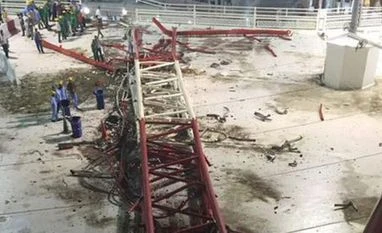
The kingdom's Civil Defence says unusually strong winds tipped over one of the massive cranes around the Grand Mosque that houses the Kaaba.
The crane crashed through part of the mosque's roof and upper floors, sending concrete slabs crashing down.
"I saw a head, legs, blood, dead people," Karam said yesterday, interviewed at her husband's bedside in Mecca's Al-Noor Specialist Hospital.
"We started saying 'Allahu Akbar, Allahu Akbar, Allahu Akbar' as the rain poured down."
She escaped injury, but her husband was among the hundreds injured, his leg broken in two parts. The death toll reached 111 yesterday as more of the injured died.
The Health Ministry yesterday said 394 people were treated at medical facilities after the crane collapse, and 158 of the injured remain hospitalised.
Ayman Shaaban, the owner of a hajj tour company in Egypt, was praying on the ground floor of the Grand Mosque when the crane collapsed.
He says he was tossed some 20 meters (66 feet). He was immediately rushed into a large room with other injured people, the right side of his face broken, bloodied and swollen, unable to open his left eye.
Saudi media reported that a committee has been established to investigate the incident. It is unclear how the kingdom's Civil Defense, which led rescue operations, was able to determine that winds caused the crane's collapse.
The spokesman for Civil Defense could not be immediately reached for comment.
Shaaban has questions about the cause of the accident. "Logically speaking, for a crane to fall from wind, even if there were strong winds, something doesn't add up," Shaaban said from his hospital bed. "If there is negligence, because of these souls lost, someone must be held accountable."
Such concerns indicate the sensitivity of the incident for Saudi King Salman, whose title is Custodian of the Two Holy Mosques, the Grand Mosque in Mecca and the first mosque built by the Prophet Muhammad in Medina.

 "Pilgrims traumatised, ask how Mecca crane could collapse")


 Connect with us on WhatsApp