
US not asking Southeast Asian nations to 'choose' on China: Mike Pompeo
The rivalry between the two superpowers is framed by a trade war that has cramped global growth, and seeded uncertainty across Asia's economies
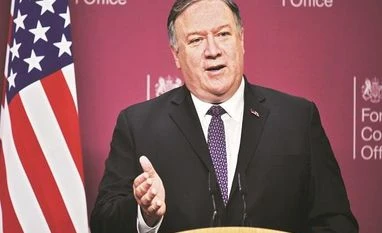 "US not asking Southeast Asian nations to 'choose' on China: Mike Pompeo")
Explore Business Standard
The rivalry between the two superpowers is framed by a trade war that has cramped global growth, and seeded uncertainty across Asia's economies
US Secretary of State Mike Pompeo insisted Thursday that Washington was not asking Southeast Asian nations to "choose" between his country and rival power China, as he trailed a rebooted security and trade strategy at a Bangkok summit.
The denuclearisation of the Korean Peninsula, a bitter trade war between the superpowers and open access to contested seas dominated talks between Pompeo and his Chinese counterpart Wang Yi on the sidelines of a summit of Southeast Asia's top diplomats.
Pompeo is tasked with reassuring Asian allies that the US remains a key player in the region as China builds up its military presence in disputed seas and airspace and cements its economic and political primacy across the region.
The rivalry between the two superpowers is framed by a trade war that has cramped global growth, and seeded uncertainty across Asia's economies.
Pompeo and Wang shook hands and smiled before the brief talks.
Both later played down the rifts between their nations, with Wang describing the meeting as a "deep communication" that "has helped to increase our mutual understanding".
"There may be various kinds of issues and problems between China and the United States," he said.
"But no matter how many problems.. we all need to sit down and continue to communicate."
In short remarks, Pompeo later insisted the US was not forcing Southeast Asian nations to "choose between countries".
"Our engagement in this region has not been and will not be a zero-sum exercise," he said, adding "our interests simply naturally converge with yours to our mutual benefit".
Among the tension points with China is the South China Sea, an area Beijing believes to be its orbit and outside the US sphere of influence.
China is accused of deploying warships, militarising outposts and ramming fishing vessels in contested waters, one of the world's key shipping routes and which the US is desperate to keep open.
Several rival Southeast Asian claimants to the sea say Beijing has used its military, economic and diplomatic heft to slow progress on a binding Code of Conduct in the flashpoint zone.
The US wants guarantees of open seas and has offered its support to several of the claimant nations in the face of Chinese aggression.
The administration of President Donald Trump, which pulled out from a massive Asia-Pacific trade pact, is pushing an "Indo-Pacific" strategy of bilateral commercial deals and security support for the region.
China rebuffs US intentions in the region and is driving through its own sweeping trade-pact for the region.
On Wednesday Wang described Southeast Asia as China's "neighbourhood" and in barely concealed warning to the US urged "non-regional countries" to not "sow distrust" in the area.
US-led efforts to tease North Korea into ending its nuclear ambitions were also covered in discussions, with Beijing's leading diplomat welcoming the high-visibility summits between Donald Trump and Kim Jong-Un.
First Published: Aug 01 2019 | 2:30 PM IST

