
Britain looking to replicate EU's external trade deals after Brexit: PM May
She also said Britain would later be able to change the terms of such trade deals
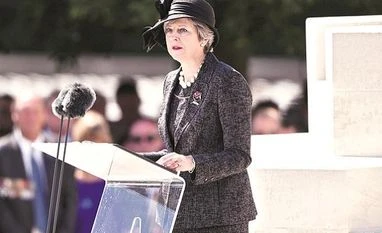 "Britain looking to replicate EU's external trade deals after Brexit: PM May")
WebinarsNew
Deep DiveNew
Explore Business Standard
She also said Britain would later be able to change the terms of such trade deals
Britain is looking at ways to replicate the trade deals that the European Union has with countries outside the bloc when it exits the EU in March 2019, Prime Minister Theresa May said on Wednesday.
The freedom to strike new trade deals independently of the EU has been highlighted by the government as a major benefit of Brexit. But businesses have repeatedly voiced concern about how existing trade relationships will work after Britain has left the bloc.
Speaking on a business trip to Japan designed to reassure investors that the British economy will flourish after Brexit, May indicated that the first step in recasting Britain as a world leader in free trade would be to copy EU trade agreements.
"There's obviously a number of trade deals that the EU has with other countries, and we are looking at the possibility of those being able to be brought over into, certainly initially, trade deals with the United Kingdom," May told reporters on her way to Japan for meetings with Prime Minister Shinzo Abe.
"I think we will give businesses certainty, which is what business wants at the point at which we leave."
She also said Britain would later be able to change the terms of such trade deals.
"Once we're outside the European Union, even if we start on the basis of an existing trade deal that a country has with the EU, it will be up to the United Kingdom and that country if we wish to renegotiate and change those terms in the future."
The EU has trade deals with external countries like Switzerland and South Korea, and is currently finalising its own deal with Japan.
Until Britain's EU membership ends it is unable to agree trade deals with external countries, and it is unclear how easily or quickly an already-stretched British civil service could transpose EU deals into bilateral trade agreements.
The position on trade is consistent with May's negotiating stance on several central issues of Brexit talks with Brussels: to closely replicate many of the existing arrangements Britain has as an EU state and then gradually introduce change.
That has drawn criticism from some eurosceptics who want to make a clean break with the EU, and EU officials who say Britain is looking to keep the benefits of membership without incurring the associated costs.
May said she was pushing for the completion of an EU-Japan trade deal, which could then be used as a model for a future British-Japan trading agreement.
"We have been one of the member states sitting around the EU table that have been pressing the EU to move forward on this deal with Japan. We think this is an important deal for the EU," she said.
(Only the headline and picture of this report may have been reworked by the Business Standard staff; the rest of the content is auto-generated from a syndicated feed.)
First Published: Aug 30 2017 | 4:41 PM IST


 Connect with us on WhatsApp