Warm rays of a slanting November sun dapple the ramparts of the old fort. The Ganges undulates in a rare “S” formation beneath, its maternal girth swollen after an unusually heavy monsoon. Across the river is the quaint Kachwa, once renowned for its excellent hospital. The British doctors who ran it are long gone, but it stands as a reminder of its past glory. Two ferries busily carry passengers, rickshaws, cattle and bicycles from Kachwa to Chunar, where I am. At a distance, a new bridge is coming up across the river. Once it is built, perhaps the age-old ferry service will also meet the fate of the Kachwa hospital. Or perhaps not. Around the Ganges in Eastern Uttar Pradesh, things tend to linger on and on. Not unlike the hoary old fort whose crumbling ramparts I’m sitting on.
A 15th-century well. Photos: Gaurav Sharma
Located in the Mirzapur district, 40 km from Varanasi, Chunar is a unprepossessing town at odds with its rich history. Legend has it that the fort here was first established by Vikramaditya, king of Ujjain, who’s been placed by some historical estimates in 1st century BCE (others argue he was merely a mythical figure). Apparently, his brother Bharathari took samadhi at this spot, and till date, a shrine within the fort commemorates this. After him, legions of rulers who passed by Chunar saw its strategic location on a cliff overlooking the river, and made the fort their own, including Babar, Sher Shah Suri, Humayun, Akbar, Aurangzeb, the British, and finally, the Provincial Armed Constabulary (PAC), which occupied it till recently. Each left its mark on the fort, and consequently, as I walk through Chunar Fort today, it feels as if different eras, different times, coexist in one ramshackle mess.
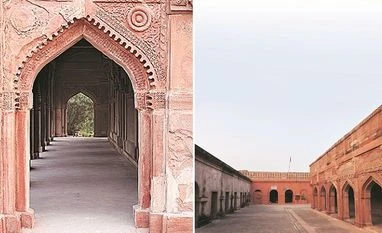
It’s a curious place, really. First, we stop to see the oldest edifice in Chunar Fort, a step-well from the 1500s. There isn’t a soul in sight, save for a drongo out for a hunt. The well bears a desolate air and we’re unsurprised to learn that it was boarded up after someone committed suicide here. Ahead is a guesthouse with a stunning view of the Ganges, rentable for the princely sum of Rs 500 per room. It is said that during the 1857 struggle for independence, this was the safe house for the British and Europeans in this district. Below it, on the banks of the river beneath the cliff, lies a Mughal era gibbet where people were executed and their bodies thrown into the river for crocodiles to consume. Further, we come across the Sonwa Mandap — a wedding pavilion built for a princess in the 1500s. The PAC, which ran its training centre here until recently, has left more modern marks everywhere. The majority of the battlements and Warren Hastings’ bungalow remain inaccessible to the public, according to PAC’s strictures.
Entrance to the Chunar Fort. Photo: Wikimedia Commons
At the foot of the Chunar Fort lies a dilapidated English cemetery with once grand tombs of once grand people. We wander among the graves and find that the oldest inscription dates back to 1802. A donkey is tethered to a tombstone inscribed by an “affectionate and disconsolate widow”. There are stories in every stone in the fort, I realise as I sidestep puddles of raw sewage and dung of mixed provenance. But sadly, Chunar Fort is caught in the vicious circle of disrepair and low popularity — the lack of facilities and maintenance means that few people visit, while the lack of visitors probably makes it less than worthwhile to maintain it. Now that the PAC has vacated the premises of the fort, the Archaeological Survey of India has undertaken to restore the fort and open all of it for the public.
The only other thing to do on a day trip to Chunar from Varanasi is visit its shops that sell traditional pottery — the large ceramic pickling jars so beloved of grandmothers, toys, idols and more. As I browse through boxes of tiny ceramic animals to use as garden ornaments, I wonder aloud if demonetisation has affected business here. “These toys are for Rs 5 each and are bestsellers,” says the shopkeeper. “Few customers run up Rs 500, leave alone Rs 1,000 notes here! I finally see some benefits in being at a place bypassed by modern development.” He’s right, I think as I pay for my purchases with Rs 20 notes and leave Chunar — a forlorn but rich time capsule that one literally has to fall off the tourist map to see.
(left) The Sonwa Mandap; (right) Inside the Chunar Fort.

 "<b>Chunar:</b> A fort from many eras")


 Connect with us on WhatsApp