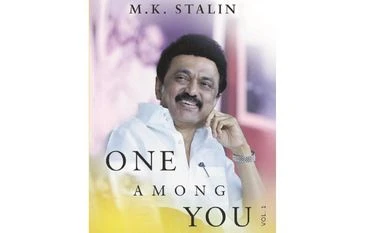
One Among You: The Autobiography of MK Stalin Volume 1
Translator: A S Panneerselvan
The politician sons of at least two Indian politicians have described their childhood and the relationship with their fathers poignantly. Former UP Chief Minister Kalyan Singh’s son Rajveer once confessed that meetings with his father were few as he was busy in politics and the children were brought up by the extended family. On one occasion, his father came home briefly, awkwardly patted Rajveer on the head and told him to work hard as he had to go to Class 8. “But I’m already in Class 8,” Rajveer replied. Similarly, Akhilesh Yadav had a troubled relationship with his father, in his case, exacerbated by the extended family. Mulayam Singh gave Akhilesh the party but not the authority to run it. It was Janeshwar Mishra, one of the pillars of Socialist politics in UP, who was his mentor and treated him like a son, sensitive to his ambitions and gentle with them.
In this book, the first volume of his autobiography, Stalin describes his relationship with his father, M Karunanidhi, who was an adored role model. Stalin grew up in a home that was imbued with Dravidian politics. His grandmother — M Karunanidhi’s mother Anjugam — never held her son back from going to prison for political causes and, indeed, held it up as a badge of pride. The first agitation to rename Dalmiapuram railway station (named after R K Dalmia) as Kallakudi because R K Dalmia, who had started a cement factory there “represented the North Indian hegemonic and exploitative business interests” was launched in 1953. It catapulted Karunanidhi into the spotlight of the Dravidian movement— he was one of those arrested for lying on the tracks in the path of an incoming train. Stalin’s mother Dayalu took her four and a half month old son to see his father in Tiruchi Central Jail. That was Stalin’s first encounter with politics.
Influenced by films, newspapers and music as a vehicle for politics, Stalin quickly embraced a life in politics. He confesses that he never thought of any other career. How could he, when the people he most admired were political figures, so much so that he confesses he ate tender tamarind shoots to make his voice sound hoarse like his father’s. However, both Karunanidhi and M G Ramachandran, who was a party colleague at the time, tried to dissuade him. He pulled back but continued to pursue other ways in which his contribution to the party would be noticed by the leadership.
That encounter with his father told Stalin that he was being noticed by Karunanidhi. After that, “I took some bold steps to engage in politics in a more open manner,” he says.
The book talks about his marriage to Durga, how the police came to arrest him during the Emergency and his father’s calm. Stalin’s son Udhayanidhi’s birth also coincided with one of Karunanidhi’s spells in prison. To keep family fires burning, Stalin had to become a film producer. But Tamil Nadu’s rich tradition of political films continued with him.
Only obliquely does Stalin refer to the controversies that surrounded his father’s family life. Karunanidhi married Dayalu after the death of his first wife who is revered in the family. But later, he acknowledged that he had two life partners — Dayalu and Rajathi, the latter the mother of the MP Kanimozhi. All Karunanidhi’s children wanted desperately to win their father’s respect. The family saw many fault-lines after Stalin’s elder brother Azhagiri felt alienated from the family and tried to beat a different path in Madurai, his area of influence. This is hardly a secret and when asked about the tension between the sons at the time, Karunanidhi replied that a “clock has two hands. Only with both of them, can you tell the correct time”. However, Stalin writes about Azhagiri with great affection, as he does about his cousins, the Maran family.

 "House of the rising son")












 Connect with us on WhatsApp