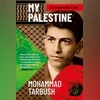
My Palestine: Tarbush's memoir captures the struggle for self-rule

Part memoir, part political history, My Palestine offers a radical solution to the long-standing conflict: The creation of a secular, democratic state with equal rights for all, regardless of religion

Book
Areeb Ahmad
5 min read Last Updated : Nov 15 2024 | 8:45 PM IST
My Palestine: An Impossible Exile 
Author: Mohammad Tarbush
Publisher: Speaking Tiger
Pages: 352 
Price: Rs 699
 
More than a year since it began, the latest assault on the Palestinian people by the Israeli Defence Forces continues unabated and has since engulfed four neighbouring countries. Despite growing global censure, UN resolutions, International Court of Justice rulings and deafening calls for a ceasefire, the violence has been steadily ramped up alongside an ever-increasing death count. In such times, a book such as My Palestine by Mohammad Tarbush becomes incredibly important and deserves to be read. Essentially an autobiography — made more poignant by the fact that Tarbush died in January 2022 before edits were completed — the book is a fascinating amalgamation of personal and political history. It traces in sweeping detail the arc of his life against the backdrop of his beloved native land.
 
Born in early 1948 during the chaos of the Nakba,  (catastrophe), the ethnic cleansing that accompanied the establishment of the state of Israel, Tarbush spent almost no time in his native village of Beit Nattif before his family was caught up in the mass displacement and violent dispossession of the Palestinian people. The family became refugees in the nearby city of Jericho and would later move to Amman, Jordan, after the 1967 war. By that time, Tarbush would be long gone. As a teen, he had quietly left his family and Jericho behind, hitchhiking to Switzerland in search of better opportunities for work and education. “I longed to escape, to shout to the world about us, to try to cure this festering wound that was defining Palestinians,” he wrote. Through good fortune and benefactors, he was able to turn his life around and become a successful international banker.
 
Even as his circumstances changed, the homeland was always at the back of his mind and Tarbush did everything in his power to support his people and champion their fight. His daughter Nada states in her Foreword: “Despite [personal success], his exile was impossible — to him — because he could never leave Palestine behind… He used every opportunity he had to start a conversation with the Western public and explain the justice of the Palestinian people’s cause, using the most prestigious platforms he could to deliver his message… Until his death, Palestine was his beacon of light.” In his own Preface, Tarbush describes the process of writing the book: “I found myself shifting between, of all things, pronouns — I, we, our  and they. My effort to avoid alternating from the first to the third person was futile. The personal narrative merged with the national history of the Palestinian people.”
 
Tarbush’s perspective developed when he was an adolescent and his political consciousness grew with age: “Resentment about the circumstances of our displacement preoccupied me. I was more and more anxious to find out about what had happened, to understand the history that lay behind stories of our flight. How could all this have been allowed to happen?”
 
When he moved from Switzerland to England for further studies, he felt the need to project his voice to the world against the dominant Zionist narrative: “To be heard over the din of that orchestrated chorus was arduous and exhausting… Part of our struggle was rooted in the problem not just of negative stereotypes about Arabs and Palestinians but in the problem that when some people heard ‘Palestinian’, they didn’t imagine a real people at all, instead believing that Palestinians are a political hoax.”
 
Tarbush also amply explores the history of Zionism as a movement and ideology, the creation of the state of Israel as well as the occupation. He provides context wherever possible, tracing Western vested interests and local instability in the region. He quotes his writings from that period that consistently argued for Palestinian self-determination and the right to return. In effect, his autobiography is an effort to fight against the constant dehumanisation of Palestinians while also calling out Palestinian leadership and its incapacity to adequately represent the people and stand firm against the powers that be. He also does not mince words in criticising the Arab world’s indifference and complicity, especially by the Gulf States, when it comes to Palestine and argues that a lack of unity and decisive action has worsened conditions.
 
Near the end of My Palestine, Tarbush advocates a one-state solution. He writes: “What is needed is a complete change of paradigm and the creation of a secular, non-racial, non-sectarian, democratic state with equal civil, political, economic and social rights for all of its citizens, regardless of their religion or ethnicity.” He goes on to briefly enumerate its features and how it can come about. Clearly, Mohammad Tarbush was an incredibly hopeful man with a positive outlook on life. He possesses the firm belief that it is never too late, that a different world order is possible. Perhaps it is better that he is not here to witness the current ethnic cleansing of Palestinians as well as the utter failure of the West’s so-called rules-based order that enables Israel and does nothing to curb its violence. That is not to say that Tarbush’s vision is unattainable. But in the current context, with Israel’s land grab in the West Bank and ethnic cleansing in Gaza rendering the long favoured two-state solution an impossibility, hopes for a harmonious one-state system look an even more distant reality. 
 
The reviewer is a Delhi-based writer, critic, and translator. He is @bankrupt_bookworm on Instagram and @Broke_Bookworm on X
 

One subscription. Two world-class reads.

Already subscribed? Log in

Subscribe to read the full story →
*Subscribe to Business Standard digital and get complimentary access to The New York Times

Smart Quarterly

₹900

3 Months

₹300/Month

SAVE 25%

Smart Essential

₹2,700

1 Year

₹225/Month

SAVE 46%
*Complimentary New York Times access for the 2nd year will be given after 12 months

Super Saver

₹3,900

2 Years

₹162/Month

Subscribe

Renews automatically, cancel anytime

Here’s what’s included in our digital subscription plans

Exclusive premium stories online

  • Over 30 premium stories daily, handpicked by our editors

Complimentary Access to The New York Times

  • News, Games, Cooking, Audio, Wirecutter & The Athletic

Business Standard Epaper

  • Digital replica of our daily newspaper — with options to read, save, and share

Curated Newsletters

  • Insights on markets, finance, politics, tech, and more delivered to your inbox

Market Analysis & Investment Insights

  • In-depth market analysis & insights with access to The Smart Investor

Archives

  • Repository of articles and publications dating back to 1997

Ad-free Reading

  • Uninterrupted reading experience with no advertisements

Seamless Access Across All Devices

  • Access Business Standard across devices — mobile, tablet, or PC, via web or app

Topics :palestineBOOK REVIEWBS Reads

Next Story