
India must push 'zero for zero' strategy to address US tariffs threat: GTRI
GTRI suggested the government identify tariff lines (or product categories) where India can eliminate import duties for American imports
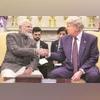 "India must push 'zero for zero' strategy to address US tariffs threat: GTRI")
WebinarsNew
Deep DiveNew
Explore Business Standard
GTRI suggested the government identify tariff lines (or product categories) where India can eliminate import duties for American imports
India should propose a 'zero-for-zero' tariff strategy to the US for addressing America's proposed reciprocal tariff hikes, as it would be less harmful than negotiating a full bilateral trade agreement, economic think tank GTRI said in its report on Friday.
Under this strategy, the Global Trade Research Initiative (GTRI) suggested the government identify tariff lines (or product categories) where India can eliminate import duties for American imports without harming domestic industries and agriculture.
In lieu of that, the US should also remove duties on a similar number of goods.
India can exclude most agriculture items from this list and to prepare it, India can refer to its Free Trade Agreement (FTA) tariff offers to Japan, Korea, and ASEAN as a starting point, it added.
GTRI Founder Ajay Srivastava said this list should be discussed with the US before April, ahead of its reciprocal tariff announcement.
It will be like doing a quick FTA in goods and if the US accepts, the reciprocal tariff may be very low or near zero for India, he said.
"India may propose a zero-for-zero strategy to the US, eliminating tariffs on 90 per cent of industrial goods to prevent aggressive tariff hikes," the report said.
Though the 'zero for zero' tariff strategy violates the rules of the World Trade Organisation (WTO), "It is less harmful compared to negotiating a full FTA, which could force India to make difficult concessions, such as opening government procurement to US firms, reducing agriculture subsidies, weakening patent protections, and removing data flow restrictions, all of which India is not prepared to accept," it added.
The report noted that US President Donald Trump's tariffs on Mexico and Canada, despite the USMCA (United States-Mexico-Canada Agreement), signal his scepticism toward trade pacts.
It added that if the US rejects the proposal, it means tariffs are not the real issue, but a tactic to pressure India for concessions in other areas.
"In such a case, India should refuse to negotiate and retaliate against unreasonable demands, taking lessons from China's approach," Srivastava said.
The US has announced a 10 per cent duty on Chinese goods. In response, China has promptly retaliated with counter-tariffs and launched antitrust probes into Nvidia and Google, it said.
Further, the report said the reciprocal tariff plan, announced on February 13 by the Trump administration, allows the US to raise tariffs on countries with which it has a trade deficit and if implemented, it could significantly impact Indian exports.
"If the US imposes a uniform tariff, Indian exports could face an additional tariff of 4.9 per cent, compared to the current 2.8 per cent," it said adding if duties are imposed sectorally, Indian farm exports would be hit "hardest", with shrimp, dairy, and processed foods facing tariffs of up to 38.2 per cent.
Industrial goods such as pharmaceuticals, diamonds and jewellery, and electronics also face major risks.
With the bilateral trade exceeding $125 billion in 2024, Indian businesses are concerned about potential losses.
"It is still unclear how the tariffs will be applied - whether at the product level, sector level, or country level. If applied at the product level (specific tariff lines), the impact may be limited, as India and the US may not trade the same products. However, if imposed at the sector level, entire industries could face serious disruptions," the report noted.
Indian farm exports to the US currently face a 5.3 per cent tariff, whereas US farm exports to India face a much higher 37.7 per cent import duty. On the other hand, for industrial products, Washington's exports to New Delhi face a 5.9 per cent weighted average tariff, while Indian industrial exports to the US face only 2.6 per cent duty.
According to the report, the US claims that while it offers low-tariff access to foreign goods, other countries impose higher tariffs and trade barriers on American products. It argues that this imbalance has led to a trade deficit exceeding USD 1 trillion, hurting American industries and workers.
To counter this, President Trump introduced the reciprocal tariff plan, allowing the US to raise tariffs on countries with perceived unfair trade practices. The US Commerce Secretary and the US Trade Representative (USTR) will review partner country policies and recommend higher tariffs, it said.
(Only the headline and picture of this report may have been reworked by the Business Standard staff; the rest of the content is auto-generated from a syndicated feed.)
First Published: Feb 21 2025 | 1:02 PM IST


 Connect with us on WhatsApp