On Tuesday (June 3), US Secretary of Commerce Howard Lutnick delivered a message that many in New Delhi may have long suspected but seldom heard in such stark terms. Speaking at the US-India Strategic Partnership Forum (USISPF) Leadership Summit, Lutnick said past Indian decisions, like defence purchases from Russia and participation in Brics, have “rubbed the United States the wrong way".
“That's a way to kind of get under the skin of America,” he said, singling out India’s military ties with Moscow and its presence in groupings like Brics, which is perceived to challenge the dollar’s global dominance. The message was blunt, but it revealed a deeper truth, despite a loud strategic and diplomatic embrace - the India-US defence partnership remains affected by mistrust, mismatched expectations, and mounting delays.
Why India-US defence partnership has not taken off
Over the last two decades, India has procured nearly $20 billion worth of US-origin military hardware, ranging from C-17 Globemaster and C-130J aircraft to Apache helicopters and M777 howitzers. More recently, India signed agreements for 31 MQ-9B SeaGuardian drones, GE jet engines for fighter aircraft, and joint production of Javelin anti-tank missiles and Stryker infantry vehicles.
But in reality, these headlines hide a growing frustration in New Delhi. Nearly all major US-origin defence deals announced in recent years are yet to materialise. Deliveries of GE-404 jet engines, which are critical to India’s indigenous Tejas fighter jet programme, have been delayed, setting the project back by at least two years. Additionally, the long-touted Indo-Pacific maritime awareness package, including the SeaVision surveillance system approved in May 2025, is yet to be delivered. Even the high-profile MQ-9B drone deal remains tangled in a web, with final assembly and maintenance arrangements still being ironed out.
These delays have cast a shadow over the defence relationship, particularly when juxtaposed with India’s parallel defence partnership with Russia. Despite geopolitical turbulence, India and Russia continue to co-develop and manufacture systems like the BrahMos missile and AK-203 rifles under the Make in India programme. Their long-standing cooperation is institutionalised through the Inter-Governmental Commission on Military Technical Cooperation (IRIGC-MTC).
US’ hesitancy in providing defence equipment and India’s ‘Aatmanirbhar’ push
At the heart of the India-US defence dilemma lies a fundamental misalignment of priorities. India seeks co-development, joint production, and above all, meaningful technology transfer to boost its self-reliance (Aatmanirbhar Bharat). The US, on the other hand, largely views India as a lucrative arms market, offering equipment but rarely the underlying know-how.
Even when co-production is agreed upon, the technologies involved are dated and old. The Javelin missile, developed in 1989 and inducted in 1996, and the Stryker vehicle from the early 2000s, are far from cutting-edge. While still effective, they represent a bygone era of warfare. In contrast, the future battlefield is increasingly being shaped by AI-enabled systems, autonomous drones, and electromagnetic weapons, domains where US-India collaboration has seen little progress.
The contrast is not just technological but economic. A single Javelin missile costs $216,717 (roughly ₹1.9 crore), while a Ukrainian anti-tank drone capable of the same battlefield effect costs just $500 (₹43,685). For India, reliant on cost-effective solutions, the Javelin is a white elephant.
What are the regulatory barriers hindering India-US defence partnership?
India’s quest for deeper military-technical collaboration with the US is hindered by a thicket of regulatory and legal barriers in the latter nation. US laws like the Arms Export Control Act (AECA) and International Traffic in Arms Regulations (ITAR) severely restrict technology transfers, especially for systems involving nuclear propulsion or fifth-generation fighter capabilities.
Conversely, India’s defence procurement system, marked by sluggish approvals, budget mismatches, and delayed offset clearances, discourages even the most well-meaning US defence firms. Structural misalignments and unresolved intellectual property concerns further hinder joint ventures.
The Defence Technology and Trade Initiative (DTTI), once hailed as a breakthrough framework for co-development, has largely under-delivered.
India’s geopolitical diplomacy a thorn in US’ eyes
India’s insistence on strategic autonomy and refusal to enter formal alliances remains a sticking point. While Washington expects alignment in Indo-Pacific military postures, New Delhi walks a tightrope, maintaining ties with the US, Russia, and France in equal measure.
This balancing act has drawn flak in Washington. India’s purchase of the Russian S-400 missile system exposed it to potential US sanctions under the CAATSA (Countering America's Adversaries Through Sanctions Act) law. While the Biden administration held back, the unpredictability of US foreign policy under the Trump administration makes long-term defence planning increasingly difficult for India.
What is the size of India’s arms import?
According to the Stockholm International Peace Research Institute (SIPRI), India was the world’s largest arms importer between 2019 and 2023, accounting for 9.8 per cent of global imports. In value terms, India’s arms imports in 2023 stood at $1.43 billion (in constant 1990 dollars), with Russia still being the largest supplier, although its share has declined from 76 per cent (2009–13) to 36 per cent (2019–23). France and the US have been the biggest gainers.
Therefore, as Lutnick’s remarks make clear, the India-US defence relationship may be moving forward, but it is still dragging its feet.


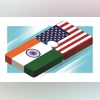 "US balks at India-Russia defence ties: What's delaying Washington's deals?")

