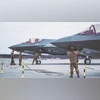
The Indian Air Force (IAF) will likely advise the government to buy stealth aircraft as and when its opinion is sought, according to a government source. The need for such a purchase is based, above all factors, on India’s threat assessment in its neighbourhood. China, which has stealth capability, is reportedly selling 40 fifth-generation fighters to Pakistan. Beijing is also making its own sixth-generation jets.
A stealth aircraft can cheat conventional sensors or delay the other side’s response in a war. US President Donald Trump recently said at a joint news conference with Prime Minister Narendra Modi that America would pave the way for an eventual sale of its stealth F-35 fighters to India.
The source said exploring the US offer, if made, would depend on the cost as well as the ecosystem needed in India to sustain the advanced aviation platform.
Defence Secretary Rajesh Kumar Singh told newswire ANI on Monday that while there’s no offer yet, India is open to studying it.
“Creating an option like this is important for us and we will certainly look at it with an open mind,” Singh said.
Defence analysts weigh in on the pros and cons of India buying the F-35. At this time, it is unclear if a deal with the US would be struck. According to retired Air Marshal P S Ahluwalia, the multirole F-35 can meet defensive and offensive requirements: its shape, body paint, and embedded weapons make radar-detection difficult, and it can strike far. It is combat-tested and manufactured in large numbers.
“The ecosystem of the F-35 will be specific to the platform but if India were to buy from the US, the logistical supply chain and other issues would need to be smooth,” Ahluwalia said. India has started its own programme to make stealth fighters, with mass production planned for 2035-36. The delivery of some non-stealth fighters, being made in India, has been delayed. Other than the regional threat assessment, such factors seem to have made the IAF anxious.
“The F-35 would be a good option for India in the interim,” Ahluwalia said, adding that ordering two squadrons (36), or 40, would make sense.
The Russia-made Su-57, another stealth fighter, was unveiled at Aero India 2025. Russia remains India’s largest defence exporter, even though New Delhi has increased the share of defence imports from other countries such as France, the US, and Israel. The Su-57 is untested in combat and doesn’t come with the information needed to make purchase decisions, Angad Singh, an independent analyst, said. “But whether to buy the F-35 is a government call,” he added.
According to R K Narang, senior fellow, Manohar Parrikar Institute for Defence Studies and Analyses, a detailed technical assessment will need to be first done by India if the F-35 is on offer in the future.
“We will need thorough deliberations – how many should we buy, what will be the delivery timeline, and most important, how will it affect our indigenisation programme,” Narang said.
India’s acquisition process itself could take at least two years to complete and then another five-to-seven years for the initial delivery, by non-conservative estimates.
“We have just started our fighter programme, but we should not panic. India is getting better at making,” Narang added.
One F-35 Lightening II jet could cost around $80 million. Plus, the maintenance cost is some $7 million.
The US Government Accountability Office reported in April 2024 that the cost to sustain the F-35 fleet through 2088 would be $1.58 trillion, according to the US Congressional Research Service data.