
Delhi air quality 'severe', farm fires account for one-third pollution
The city's Air Quality Index (AQI) stood at 421, worsening from 395 at 4 pm on Tuesday. Delhi's air quality ranks among the worst in the world's capital cities.
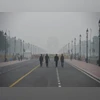 "Delhi air quality 'severe', farm fires account for one-third pollution")
WebinarsNew
Deep DiveNew
Explore Business Standard
The city's Air Quality Index (AQI) stood at 421, worsening from 395 at 4 pm on Tuesday. Delhi's air quality ranks among the worst in the world's capital cities.
Air quality in Delhi and its suburbs dropped to the severe category again on Wednesday morning, with smoke from post-harvest paddy straw burning in neighbouring states accounting for one-third of the air pollution in the national capital.
The city's Air Quality Index (AQI) stood at 421, worsening from 395 at 4 pm on Tuesday.
Despite a marginal dip, the concentration of PM2.5, fine particulate matter capable of penetrating deep into the respiratory system and triggering health problems, exceeded the government-prescribed safe limit of 60 micrograms per cubic metre by seven to eight times in the capital.
It was 30 to 40 times the healthy limit of 15 micrograms per cubic metre set by the World Health Organisation (WHO).
Several cities across the Indo-Gangetic plains reported hazardous air quality. Neighbouring Ghaziabad (382), Gurugram (370), Noida (348), Greater Noida (474), and Faridabad (396) also reported hazardous air quality.
According to data from the Decision Support System, a numerical model-based framework capable of identifying sources of particulate matter pollution in Delhi, stubble burning in neighbouring states, especially Punjab and Haryana, accounted for 37 percent of the air pollution in Delhi on Tuesday. It is likely to be 33 percent on Wednesday.
The Delhi government on Monday announced the return of its flagship odd-even scheme after four years anticipating further deterioration of air quality post-Diwali.
The odd-even scheme, under which cars are allowed to operate on alternate days based on their odd or even number plates, will be implemented between November 13 and November 20.
The Energy Policy Institute at the University of Chicago (EPIC) and Evidence for Policy Design had analysed the impact of the odd-even system in 2016 and found that Delhi saw a 14-16 per cent reduction in PM2.5 levels during the hours it remained in force in January that year. However, there was no reduction in pollution when the scheme was brought back in April that year.
To protect the health of school children, the government also decided to suspend in-person classes in all schools, except for students in grades X and XII preparing for board exams, until November 10.
According to the Ministry of Earth Sciences' Air Quality Early Warning System for Delhi-NCR, the region is likely to experience severe air quality for another five to six days.
Doctors say breathing in the polluted air of Delhi is equivalent to the harmful effects of smoking approximately 10 cigarettes a day.
Prolonged exposure to high levels of pollution can cause or exacerbate respiratory problems such as asthma, bronchitis, and chronic obstructive pulmonary disease (COPD) and can dramatically raise the risk of cardiovascular disease, said Rajesh Chawla, senior consultant in pulmonology and critical care at the Indraprastha Apollo Hospital.
Stringent restrictions mandated under the final stage of the Central government's air pollution control plan for Delhi-NCR, called the Graded Response Action Plan (GRAP), have also been implemented in Delhi.
The restrictions under stage IV of GRAP, including a ban on all kinds of construction work and the entry of polluting trucks into the capital, took effect on Sunday after air quality in the capital dropped to severe plus (AQI above 450) levels.
GRAP categorises actions into four stages: Stage I - Poor (AQI 201-300); Stage II - Very Poor (AQI 301-400); Stage III - Severe (AQI 401-450); and Stage IV - Severe Plus (AQI above 450).
Unfavourable meteorological conditions, combined with vehicular emissions, paddy straw burning, firecrackers, and other local pollution sources, contribute to hazardous air quality levels in Delhi-NCR during the winter every year.
According to a Delhi Pollution Control Committee (DPCC) analysis, the capital experiences peak pollution from November 1 to November 15 when the number of stubble-burning incidents in Punjab and Haryana increases.
Air quality in Delhi-NCR declined over the last two weeks due to a gradual drop in temperatures, calm winds that trap pollution, and a surge in post-harvest paddy straw burning across Punjab and Haryana.
Delhi's air quality ranks among the worst in the world's capital cities.
A report by EPIC in August said that air pollution is shortening lives by almost 12 years in Delhi.
(Only the headline and picture of this report may have been reworked by the Business Standard staff; the rest of the content is auto-generated from a syndicated feed.)
First Published: Nov 08 2023 | 10:44 AM IST

