
SC refuses to stay Hindu prayers in southern cellar of Gyanvapi mosque
A bench headed by Chief Justice D Y Chandrachud also sought the response of priest Shailendra Kumar Pathak Vyas by April 30 on the plea of the mosque committee
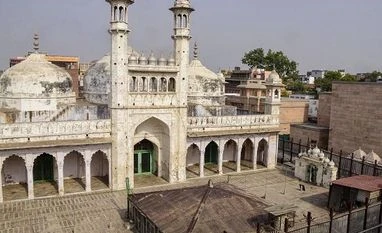 "SC refuses to stay Hindu prayers in southern cellar of Gyanvapi mosque")
Explore Business Standard

Associate Sponsors
Co-sponsor
A bench headed by Chief Justice D Y Chandrachud also sought the response of priest Shailendra Kumar Pathak Vyas by April 30 on the plea of the mosque committee
The Supreme Court on Monday refused to stay the Hindu prayers in the southern cellar of the Gyanvapi mosque in Varanasi even as it ordered a "status quo" on the religious observances by both the Hindu and Muslim sides inside the mosque premises.
The court was hearing a fresh plea of the Gyanvapi mosque management committee against an Allahabad High Court decision upholding a lower court's order allowing Hindu prayers in the southern cellar of the mosque.
The top court noted that both the Muslim and Hindu sides have been conducting their respective religious observances "unhindered" inside the mosque premises and, therefore, a status quo would serve the ends of justice for now.
A bench headed by Chief Justice D Y Chandrachud also sought the response of priest Shailendra Kumar Pathak Vyas by April 30 on the plea of the mosque committee.
"Bearing in mind the fact that the namaz is offered by the Muslim community unhindered after the orders dated January 17, 2024 and January 31, 2024, and the offering of pooja by Hindu priest is confined to the area of tehkhana, it is appropriate to maintain status quo so as to enable both the communities to offer worships in the above terms.
"The religious observances by the Hindus shall be in terms of directions contained in the order dated January 31, 2024... Status quo as obtained from the above terms shall not be disturbed without obtaining the previous sanction and leave of this court," the bench, also comprising justices J B Pardiwala and Manoj Misra, said.
The apex court, after seeing the Google Earth images of the structures, noted that the entry to the cellar is from the southern side while the entry to the mosque for the purposes of offering namaz is from the steps on the northern side.
At the outset, senior advocate Huzefa Ahmadi, appearing for Anjuman Intezamia Masjid Committee, sought a stay on the civil court's order and submitted that puja was being allowed to take place within the mosque premises.
Ahmadi said this will only fester some discord.
"History has taught us some other lessons where violence has happened despite assurances. This is an egregious order. Communities have lived peacefully. Why this insistence on having this now? For 30 years the situation has been very normal," he submitted.
Ahmadi alleged that Hindu parties filing multiple applications for different reliefs and and there is serious apprehension that bit by bit the Muslim side will lose out the whole mosque.
Referring to the Ram Janmabhoomi-Babri Masjid dispute, Ahmadi said,"We are in your hands and we know what happened at Ayodhya and despite of interim orders the mosque Babri Masjid could not be protected. This is what history taught us."
Senior advocate Shyam Divan, representing the Hindu parties, submitted that the orders do not warrant any intervention by the apex court at this stage as there are detailed reasons in the trial court and the high court orders.
The high court, on February 26, had dismissed the committee's plea in which it had challenged the district court's January 31 order allowing Hindus to offer prayers in the cellar.
While dismissing the plea of the mosque committee, the high court had observed that the Uttar Pradesh government's 1993 decision of stopping worship rituals inside the 'Vyas Tehkhana' -- located at the southern cellar of the Gyanvapi -- was "illegal".
The high court said worship will continue in the 'Vyas Tehkhana' of the mosque adjacent to the Kashi Vishwanath temple.
A survey conducted by the Archaeological Survey of India (ASI) on the court's order had suggested that the Gyanvapi mosque was constructed during Mughal emperor Aurangzeb's rule over the remains of a Hindu temple.
The district court ruled on January 31 that a Hindu priest can perform prayers before the idols in the southern cellar of the mosque.
The prayers are now being conducted by a Hindu priest nominated by the Kashi Vishwanath temple trust and the petitioner, who has claimed that his grandfather offered puja in the cellar till December 1993.
The district court had directed the local administration to make arrangements within seven days for prayers in the cellar. This would have involved "proper arrangements" with metal barricades at the complex.
The January 31 order of the district court was delivered on the plea of Shailendra Kumar Pathak, who had claimed that his maternal grandfather, priest Somnath Vyas, offered prayers in the cellar till December 1993.
He had said puja was stopped during the tenure of then Uttar Pradesh chief minister Mulayam Singh Yadav after the Babri masjid in Ayodhya was demolished on December 6, 1992.
The suit was filed against the action of the state government and district administration restricting the plaintiff to enter the said temple and fundamental right granted under Article 25 of the Constitution being infringed.
First Published: Apr 01 2024 | 6:50 PM IST

