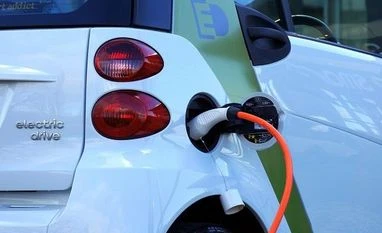
Electric-vehicle (EV) makers are in talks with the Centre on a concrete policy to decouple the battery from the EV and develop a nation-wide battery-swapping infrastructure, said multiple people close to the development.
With the FAME-II (Faster Adoption and Manufacturing of Electric and Hybrid Vehicles in India) subsidy going in 2024, this move can reduce the cost of purchase, and thereby fuel EV adoption, the industry says.
Some industry players say by 2025 India may have a nationwide policy of decoupling batteries from EVs, and swapping infrastructure. Batteries typically constitute 40-50 per cent of an EV’s cost.
A senior government official said meetings of stakeholders had been happening for over a year now; and at the moment work on standardising the battery used in vehicles is on.
“Stakeholder meetings happened in January-March. The NITI Aayog had submitted its draft battery-swapping policy document last year. Now work on coming up with battery standards is on and this would be happening under the Bureau of Indian Standards, which comes under the Ministry of Consumer Affairs,” the official said, requesting anonymity. He added once the standards were ready, there would be more stakeholder meetings.
The EV industry seems to be geared up for the change.
Ayush Lohia, chief executive officer (CEO) of Lohia Auto, who has been part of industry-government stakeholder meetings, said this move was critical in achieving cost-competitiveness and making electric two-wheelers more attractive in the market.
“The electric two-wheeler segment, which accounts for 55 per cent of India’s EV industry, is facing significant pressure to reduce the cost of electric scooters. The impact of subsidy reduction on EVs is particularly pronounced in this segment, because buyers have limited purchasing power and may opt for petrol-driven two-wheelers, given the circumstances,” he said.
In this case, the consumer will not have to buy the battery with the vehicle. But it would be more like battery-as-a-service (BaaS). The NITI Aayog said in its draft report published last year: “Battery swapping falls under the broader umbrella of Battery as a Service (BaaS) business models which involve users purchasing an EV without the battery, which significantly lowers upfront costs, and paying a regular subscription fee (daily, weekly, monthly, etc.) to service providers for battery services throughout the vehicle lifetime.”
Lohia also said the Centre needed to work out the GST (goods and services tax) implications of such a move. EVs come under the 5 per cent slab, whereas service providers of batteries will fall under a different one.
Sohinder Gill, director general of the Society of Manufacturers of Electric Vehicles (SMEV) and CEO of Hero Electric, told Business Standard if implemented properly, decoupling batteries from EVs could prove to be a game-changer because India was a cost-conscious market. But it needs battery standardisation so that a single battery can fit several brands.
“Some in the industry are concerned this might erode their technological edge over other brands. For high-performance two-wheelers, it can prove to be a dampener. Moreover, we also need to ensure the density of battery-swapping stations so that there is no range anxiety,” Gill said.
He added within the next two years one could expect to see a move towards an ecosystem of EVs with swappable batteries.
Some, however, feel that the one-size-fits-all policy won’t work.
Nikhil Bhatia, co-founder of HOP Electric, an electric bike maker, said: “This will work best for urban logistics companies that can swap batteries on the go, and for entry- and mid-level EVs. But for 110-120 kmph top-speed high-performance EV two-wheelers, this can be not so effective,” Bhatia said.
But small proofs of concept are already there, Bhatia said.
Another National Capital Region-based start-up Chargeup is building a swap-station network. Varun Goenka, CEO and cofounder, said the firm had a network of 300 swap stations and 3,000 drivers on its platform.
Delhi Chief Minister Arvind Kejriwal inaugurated 140 public EV charging points and 48 battery-swapping stations at 56 locations in the city last Tuesday.
In progress
- About 80% of the electric vehicles in India today are e-rickshaws
- There are over 2.4 mn such vehicles in the country transporting about 140 mn people each day
- Stakeholder meetings between industry and Centre are on for battery swapping policy
- Standardisation of batteries can act as deterrent for R&D and tech-upgrade
- India is committed to achieving net-zero emissions by 2070
- With existing technologies for e-2Ws and e-3Ws, regular charging takes at least 3 to 4 hours