A casual attitude to safety

The tragic train accident in Odisha highlights India's neglect of safety and quality in infrastructure
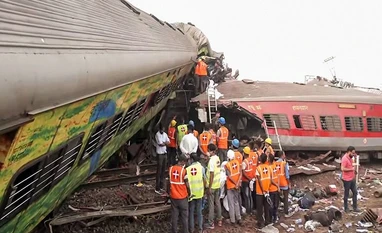
Odisha Train accident
To be fair, train accidents have been decreasing over time and the number of consequential (or serious) accidents has reduced over the years
Prosenjit Datta
5 min read Last Updated : Jun 05 2023 | 9:01 PM IST
India has just witnessed its most horrific train accident in over two decades. At the time of writing this column, official estimates put the number of deaths at 275, with over 1,000 injured. It involved three trains — the Coromandel Express, which derailed and then hit a stationary goods train before being hit by the Bengaluru-Howrah Superfast Express coming from another line. Initial reports had suggested a signalling and switching error/malfunction as the probable cause, though the investigation has now been handed over to the Central Bureau of Investigation (CBI).

If this tragic accident was not bad enough, a bus carrying some of the injured persons from the train accident site in Balasore to a hospital had a head-on collision with a van in Bengal’s Medinipur district. Finally, even as this column is being written, videos of the collapse of an under construction bridge in Bihar are going viral on social media.

Investigations will eventually give the reasons behind the tragic train accident, the bus mishap and the bridge collapse. They are not linked by anything other than the fact that the issue of safety and quality in India has never been a high priority — either for various governments or for citizens. There has been little effort to analyse and then find ways to reduce the accidents while improving the safety of citizens.

To be fair, train accidents have been decreasing over time and the number of consequential (or serious) accidents has reduced over the years. But given our large railways network — the fourth-largest in the world at 68,043 km — and the 3.5 billion people who travel on this network annually, the number of railway accidents and the number of people who die because of these mishaps make for grim statistics. According to the National Crime Records Bureau, an average 23,000 people died every year between 2010 and 2021 in railway accidents.

Deaths due to road accidents are far more numerous. A report by the Ministry of Road Transport and Highways in 2021 put the total number of road accidents that year at 412,432, claiming 153,972 lives while causing injuries to 384,448 persons. Meanwhile, when it comes to bridge collapses, a study which came out a few years ago, counted 2,130 bridges that had collapsed between 1977 and 2017. If one were to take roads and highways that have simply sunk because of bad construction, it would run into hundreds, if not thousands, every year.

There are four primary reasons for accidents — and deaths and injuries due to accidents. They are faulty design, poor maintenance and wear and tear, improper safety protocols and regulations, and finally human error, sometimes compounded by fatigue and boredom. A fifth, wilful flouting of safety regulations and norms, merits a separate discussion because it has to do with both societal attitudes as well as law enforcement.

India scores poorly in all the areas listed above. Examples of faulty/bad design in our highways and bridges and other infrastructure are abundant. Every highway, modern or old, has several well-identified “death traps” — spots where the majority of bad accidents take place primarily because of bad design. These death traps are rarely ever rectified, even though the body count keeps mounting.

Poor maintenance and wear and tear are common in every piece of public and even in privately maintained infrastructure and there are plenty of examples. The Morbi Bridge tragedy in Gujarat a few months ago is just one example, but there are hundreds of others.

In the Indian Railways itself, a 2022 report by the Comptroller and Auditor General (CAG) of India had pointed to a host of lapses — shortfalls in inspection, low utilisation of the dedicated railway fund for the specific purpose of safety, and even the failure to submit or accept inquiry reports.

Unsuitable safety and quality protocols are something that every Indian citizen experiences daily — from cars that would not meet crash test regulations in a developed country to the tardy implementation of seat belts in automobiles, as well as poor safety standards and implementation in food and drug specifications and labelling.

Finally, there is the human error — sometimes because of long hours and fatigue. This in turn can be traced back to not hiring and training enough people for the safety functions. The 2022 CAG report had also pointed to the huge shortfall in staffing, especially in the safety category of the Indian Railways.

The CAG report on railways is not the only one highlighting these issues. There are over a dozen studies on problems that ail our highways, railways, and bridges when it comes to safety measures and quality issues.

Why weren’t these issues addressed? Perhaps, it is because consumer and citizen safety has never been a priority for successive governments. Or, perhaps because Indian citizens after each tragedy tend to blame their fate, instead of holding the authorities responsible for poor safety and quality enforcement.

Despite the clamour for accountability and hope that lessons will be learnt, the next accident invariably shows that nothing has been learnt — or if learnt, they have been ignored. One can only hope that this time it will be different, though one fears it will not be the case.
The writer is former editor Business Today and Businessworld, and founder of Prosaic View, an editorial consultancy

One subscription. Two world-class reads.

Already subscribed? Log in

Subscribe to read the full story →
*Subscribe to Business Standard digital and get complimentary access to The New York Times

Smart Quarterly

₹900

3 Months

₹300/Month

SAVE 25%

Smart Essential

₹2,700

1 Year

₹225/Month

SAVE 46%
*Complimentary New York Times access for the 2nd year will be given after 12 months

Super Saver

₹3,900

2 Years

₹162/Month

Subscribe

Renews automatically, cancel anytime

Here’s what’s included in our digital subscription plans

Exclusive premium stories online

  • Over 30 premium stories daily, handpicked by our editors

Complimentary Access to The New York Times

  • News, Games, Cooking, Audio, Wirecutter & The Athletic

Business Standard Epaper

  • Digital replica of our daily newspaper — with options to read, save, and share

Curated Newsletters

  • Insights on markets, finance, politics, tech, and more delivered to your inbox

Market Analysis & Investment Insights

  • In-depth market analysis & insights with access to The Smart Investor

Archives

  • Repository of articles and publications dating back to 1997

Ad-free Reading

  • Uninterrupted reading experience with no advertisements

Seamless Access Across All Devices

  • Access Business Standard across devices — mobile, tablet, or PC, via web or app

More From This Section

Disclaimer: These are personal views of the writer. They do not necessarily reflect the opinion of www.business-standard.com or the Business Standard newspaper

Topics :BS OpinionOdisha Train Accident

Next Story



