A tough climate: COP29 meeting is not expected to yield much progress

COP29 intends to build on that consensus by putting funding by the Global North front and centre. But the prospects of convincing developed countries to loosen the purse-strings appear bleak

Mukhtar Babayev, Mukhtar, COP29 President
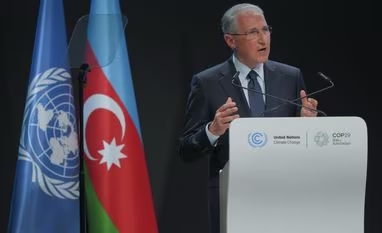
Mukhtar Babayev, COP29 President, speaks during the opening plenary session at the COP29 U.N. Climate Summit in Baku, Azerbaijan. (Photo: PTI)
Business Standard Editorial Comment
3 min read Last Updated : Nov 11 2024 | 10:17 PM IST
This year may have been the hottest on record but the Conference of Parties (COP29) meeting at Baku is expected to generate much heat and little light on the way forward for the climate-change agenda. The problems begin with the host nation. Azerbaijan’s heavy dependence on fossil fuel, the chief cause of climate change, makes it a poor exemplar for the issue at hand. Second, the world’s most critical players — the United States, the European Union, and Brazil (and host for COP30 next year) — are expected to stay on the sidelines. The minister for environment, forest and climate change for India, the world’s third-largest fossil-fuel emitter, is also unlikely to attend and the country does not have an official pavilion at the venue. Third, the meeting takes place under the shadow of Donald Trump’s impending accession to the White House, when the US will exit, yet again, the UN’s Framework of Climate Change negotiations under which COP meetings are held. With the world’s second-largest emitter and key source of climate finance out of the purview of climate-change negotiations, the entire exercise becomes moot.
 
COP29 is the second of three summits under the presidencies of the United Arab Emirates (COP28 in 2023), Azerbaijan, and Brazil, collectively known as the COP presidential “troika”. It was formed to support continuity and progress in resetting the road map to keep global temperatures from rising above 1.5 degrees Celsius. COP28 in Dubai last year involved a “global stock take” of climate-change action. It revealed just how far off the world had veered from the Paris Agreement targets of 2015 and yielded a “UAE consensus” on country responses. The consensus was considered ground-breaking because it included an agreement to transition away from fossil-fuel energy systems for the first time in more than two decades of negotiations.
 
COP29 intends to build on that consensus by putting funding by the Global North front and centre. But the prospects of convincing developed countries to loosen the purse-strings to underwrite developing countries’ adaptation and mitigation goals appear bleak. The original climate-finance goal of $100 billion per year between 2020 and 2025 was considered a fraction of the sum required, and it was met only once. One index of the poor response can be had from a fund operationalised at COP28 for developing countries suffering loss and damage from events such as wildfires and hurricanes. So far, only $661 million has been pledged, laughably short of actual requirements. Now, a proposed New Collective Quantified Goal (NCQGs) to be agreed at COP29 is likely to raise the requirement to trillions. Deep disagreements on who should pay how much and what form the payments should take have also stalled the COP29 agenda to mobilise private finance channels. Carbon markets, which were expected to be a key means of raising finance, have proved difficult to operationalise.
 
COP29 could also witness the submission of first revised nationally determined contributions (NDCs) since the Paris Agreement, ahead of the February 2025 deadline, with the “troika” leading the way by submitting NDCs aligned to the 1.5 degrees Celsius goal and guided by the UAE consensus. But as with Paris, the voluntary nature of these pledges and the absence of penalties for violations make such climate-change pledges academic exercises rather than meaningful contributions to addressing the climate-change crisis.
 

One subscription. Two world-class reads.

Already subscribed? Log in

Subscribe to read the full story →
*Subscribe to Business Standard digital and get complimentary access to The New York Times

Smart Quarterly

₹900

3 Months

₹300/Month

SAVE 25%

Smart Essential

₹2,700

1 Year

₹225/Month

SAVE 46%
*Complimentary New York Times access for the 2nd year will be given after 12 months

Super Saver

₹3,900

2 Years

₹162/Month

Subscribe

Renews automatically, cancel anytime

Here’s what’s included in our digital subscription plans

Exclusive premium stories online

  • Over 30 premium stories daily, handpicked by our editors

Complimentary Access to The New York Times

  • News, Games, Cooking, Audio, Wirecutter & The Athletic

Business Standard Epaper

  • Digital replica of our daily newspaper — with options to read, save, and share

Curated Newsletters

  • Insights on markets, finance, politics, tech, and more delivered to your inbox

Market Analysis & Investment Insights

  • In-depth market analysis & insights with access to The Smart Investor

Archives

  • Repository of articles and publications dating back to 1997

Ad-free Reading

  • Uninterrupted reading experience with no advertisements

Seamless Access Across All Devices

  • Access Business Standard across devices — mobile, tablet, or PC, via web or app

Topics :Climate ChangeBusiness Standard Editorial CommentUAE

Next Story