Investing in electric mobility

R&D will help lower import dependence
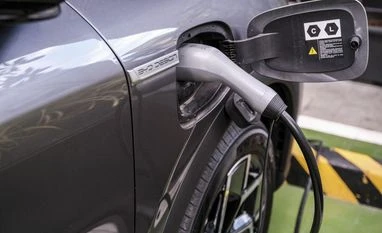
Electric vehicle, EV
Photo: Bloomberg
Business Standard Editorial Comment
3 min read Last Updated : Jul 18 2024 | 10:03 PM IST
India’s aim to achieve a 45 per cent reduction in emission intensity by 2030 and cut emissions to net zero by 2070 hinges, to a large extent, on its ability to embrace electric mobility. The country has already positioned itself as one of the fastest-growing electric vehicle (EV) markets globally. To improve the position, the Principal Scientific Advisor to the Government of India recently released a detailed report on augmenting research and development (R&D) strategy for e-mobility. The report calls for wider adoption of EVs, with manufacture of indigenous energy storage systems, generation of renewable energy to feed charging infrastructures, and development of sustainable materials and recycling methods.

According to data released by the Federation of Automobile Dealers Associations, in 2023-24, annual EV sales in India surged to 1.75 million units, an impressive 40.31 per cent year-on-year increase. The growth in the EV market can be attributed to initiatives like the National Auto Policy 2018 and the National Electric Mobility Mission Plan 2020. Besides, the government’s flagship scheme, Faster Adoption and Manufacturing of (Hybird &) Electric Vehicles, or (FAME) -II, which concluded earlier this year, prioritised the electrification of the two-wheeler and three-wheeler segments. These two segments together account for 98 per cent of vehicles targeted under the scheme and dominate the market for on-road vehicles in India.

As part of the EV30@30 target, India aims to increase EVs’ share in newly registered private cars to 30 per cent, in buses to 40 per cent, in commercial cars to 70 per cent, and in two- and three-wheelers to 80 per cent by 2030. However, the high cost of ownership and inadequate charging infrastructure remain a challenge. Further, on the production side, the e-mobility value chain depends heavily on imports. Domestic EV manufacturing is still confined primarily to vehicle assembly, while essential components related to batteries and electronic chips lack domestic capacity and scale. Weak supply chains and inadequate domestic component manufacturers lead to a heavy dependence on countries like China for components and technologies. Reducing dependence on imports within the e-mobility sector will require strengthening domestic research capabilities in the automotive sector. For instance, as an alternative to lithium, 70 per cent of which is imported from China, the report suggests exploration of novel cell chemistries like sodium-ion, lithium-air, aluminium-air, and lithium-sulphur, which may act as potential replacements for lithium-ion batteries. The report estimates that around Rs 1,200 crore investment is needed to support R&D across 30 to 34 crucial areas in e-mobility.

For funding, various government departments, including the National Research Foundation, the Ministry of Road Transport and Highways, and the Ministry of Heavy Industries can come together. In fact, investment in R&D must come from both the public and private sectors. Some of the projects that need to be undertaken are outlined in the report. These include research on advanced liquid electrolytes for lithium-ion batteries, dynamic charging systems for EVs, enhanced fuel-cell efficiency, and the development of liquid organic hydrogen carrier storage technology for fuel-cell EVs. Investing in the fundamental science behind the manufacturing of EVs will propel India to attain global leadership in value and supply chains a few years down the line. However, overall environmental gains will remain limited as long as India continues to depend on coal-fired plants as the primary power source.

One subscription. Two world-class reads.

Already subscribed? Log in

Subscribe to read the full story →
*Subscribe to Business Standard digital and get complimentary access to The New York Times

Smart Quarterly

₹900

3 Months

₹300/Month

SAVE 25%

Smart Essential

₹2,700

1 Year

₹225/Month

SAVE 46%
*Complimentary New York Times access for the 2nd year will be given after 12 months

Super Saver

₹3,900

2 Years

₹162/Month

Subscribe

Renews automatically, cancel anytime

Here’s what’s included in our digital subscription plans

Exclusive premium stories online

  • Over 30 premium stories daily, handpicked by our editors

Complimentary Access to The New York Times

  • News, Games, Cooking, Audio, Wirecutter & The Athletic

Business Standard Epaper

  • Digital replica of our daily newspaper — with options to read, save, and share

Curated Newsletters

  • Insights on markets, finance, politics, tech, and more delivered to your inbox

Market Analysis & Investment Insights

  • In-depth market analysis & insights with access to The Smart Investor

Archives

  • Repository of articles and publications dating back to 1997

Ad-free Reading

  • Uninterrupted reading experience with no advertisements

Seamless Access Across All Devices

  • Access Business Standard across devices — mobile, tablet, or PC, via web or app

Topics :Business Standard Editorial CommentElectronic vehicles

Next Story



