Trade policy reforms urged as India, US eye deal before tariff deadline

India should consider broader trade liberalisation
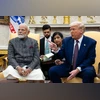
PM Modi, Donald Trump
Image: Bloomberg
Business Standard Editorial Comment Mumbai
3 min read Last Updated : Apr 23 2025 | 11:54 PM IST
United States (US) Vice-President J D Vance’s visit to India has featured the announcement that the terms of reference for trade discussions between the two nations have been finalised. The timeline on these discussions has already been set: Prime Minister Narendra Modi and US President Donald Trump agreed during the former’s visit to Washington to come up with a deal by Fall. But the more pressing deadline is the expiry of the 90-day “pause” on Mr Trump’s unilateral tariffs on various countries, in which he hit Indian imports into the US with a 26 per cent levy. Before that point, some initial agreement should ideally be signed so that the tariffs are not reimposed. A group of Union commerce ministry officials is visiting Washington this week to try and move the negotiations forward. It is worth noting that the US system is under considerable stress, given that several nations are also trying to work out bespoke deals with Washington within the 90-day deadline.
 
In this context, it is worth noting that there appears to be no relaxation in US demands on India. A factsheet issued by the US Trade Representative (USTR) has claimed that India’s trade policies exhibit a “serious lack of reciprocity” vis-a-vis the US. This extends to both tariff and non-tariff barriers, according to US officials. They have argued that India’s average applied rate is 17 per cent, as distinct from 3.3 per cent of the US, though it has increased after April 2. Of course, this is for all trade, not bilateral trade, which somewhat distorts the figures. Both Mr Vance and the USTR office also highlighted “non-tariff barriers”, which, they say, India applies, reducing market access in services, industry, and agriculture. There is some truth to the American argument.
 
However, as Union Finance Minister Nirmala Sitharaman said during her visit to the US, restrictions on trade are a global trend at the moment. She pointed out there had been a threefold increase in such restrictions since 2019. The government would do well to use this opportunity to reform trade policy. Growth in regulatory barriers in recent years, including through the use of quality-control orders, has been particularly harmful. It is also necessary to find some mechanism by which parts of agricultural markets can be made more open in India, while also restructuring domestic support to farmers so that there is no loss of welfare. This has always been one of the government’s desires, and now is the time to act on it. But it should be done for reasons other than pressure from the US, and have general applicability to all trading partners.
 
After all, the US under the current administration has demonstrated no consistency and coherence when it comes to its own approach to the economy or to global markets. It has unleashed enormous uncertainty on the markets, which may have done long-term damage to the world economy. Nor can it be trusted to hold deals. Thus, a bilateral trade agreement with the US must be part of a broader trade liberalisation in India, which includes trade deals with the United Kingdom and the European Union. While the timeline might be set by Washington, the decisions eventually must be taken in New Delhi.

One subscription. Two world-class reads.

Already subscribed? Log in

Subscribe to read the full story →
*Subscribe to Business Standard digital and get complimentary access to The New York Times

Smart Quarterly

₹900

3 Months

₹300/Month

SAVE 25%

Smart Essential

₹2,700

1 Year

₹225/Month

SAVE 46%
*Complimentary New York Times access for the 2nd year will be given after 12 months

Super Saver

₹3,900

2 Years

₹162/Month

Subscribe

Renews automatically, cancel anytime

Here’s what’s included in our digital subscription plans

Exclusive premium stories online

  • Over 30 premium stories daily, handpicked by our editors

Complimentary Access to The New York Times

  • News, Games, Cooking, Audio, Wirecutter & The Athletic

Business Standard Epaper

  • Digital replica of our daily newspaper — with options to read, save, and share

Curated Newsletters

  • Insights on markets, finance, politics, tech, and more delivered to your inbox

Market Analysis & Investment Insights

  • In-depth market analysis & insights with access to The Smart Investor

Archives

  • Repository of articles and publications dating back to 1997

Ad-free Reading

  • Uninterrupted reading experience with no advertisements

Seamless Access Across All Devices

  • Access Business Standard across devices — mobile, tablet, or PC, via web or app

Topics :Business Standard Editorial CommentLiberalisationPolitics

Next Story


