Wrestling with inaction

Stalling on sexual harassment case is regressive
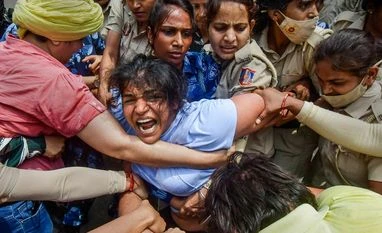
Wrestlers Protest
Security personnel detain wrestler Sakshi Malik during wrestlers protest march towards new Parliament building, in New Delhi, on Sunday. Photo: PTI
Business Standard Editorial Comment
3 min read Last Updated : Jun 12 2023 | 9:52 PM IST
It has been five and a half months since women wrestlers levelled serial sexual-harassment charges against Brij Bhushan Sharan Singh, head of the Wrestling Federation of India and a powerful member of Parliament (MP) of the ruling party. But in a bizarre and disturbing series of events, it is the complainants who have been manhandled by the police and are still seeking justice. Mr Singh remains at large despite having two first information reports (FIRs) filed against him, that too under pressure from the Supreme Court. Over the weekend, he defiantly held a rally, at which he declared his intention to contest the parliamentary election next year. At least one of the two FIRs was filed under Section 10 of the Prevention of Children from Sexual Offences Act, since the complainant is a minor. This alone should have invited immediate action against Mr Singh. Instead, the Delhi Police have begun a belated exercise to question Mr Singh and his staff to get his version of events.

In the meantime, the minor has withdrawn her complaint, a circumstance that has raised eyebrows, though her father has insisted no coercion was involved. The Delhi Police have also adopted a unique investigative modus operandi that contradict detailed standard operating procedures in the 10-year-old Prevention of Sexual Harassment Act. In a crime that hinges on “she said/he said” situations, this law has stipulated the standard of proof clearly: The complainant’s version of events must be accepted if there is corroborating evidence. The wrestlers’ complaints have unambiguously qualified for this burden of proof; at least one international wrestling referee confirmed that he witnessed inappropriate behaviour by Mr Singh towards the women wrestlers on multiple occasions. Bizarrely, the police have not only chosen to interview the women at premises on which Mr Singh was present at the same time, but have also reportedly demanded photographic evidence of Mr Singh’s behaviour, suggesting either an innate misunderstanding of the nature of sexual harassment or an attempt at obfuscation.

Though much depends on the nature of the charge sheet that the Delhi Police have committed to file by June 15, the bigger issue is the loud silence from other voices. The absence of support from current sportspeople, with the honourable exception of the cricket team of 1983 (though Board of Control for Cricket in India President Roger Binny opted out), is understandable, given the clout the government wields over sports administration. But apart from associations of farmers, the communities to which the wrestlers belong, not many Opposition politicians of note have cared to speak up in defence of these women, not even those who count themselves as implacable opponents of the ruling party. More unusually, no women’s organisations have chosen to hold the kind of mass sit-in protests seen in 2012, which compelled Parliament to pass workplace sexual harassment laws and tighten the rape laws.

This collective indifference underlines the fact that gender justice is not a resonant electoral issue in a society where patriarchy is deeply entrenched. Twenty-first century India has justly been proud of the growing number of women graduates and the achievements of its women in many diverse walks of life, of which the medal-winning wrestlers are a proud example. But the public spectacle of prominent sports women’s stubborn fight to be heard against entrenched male supremacy is regressive. As it stands, the controversy does India’s international image no favours.

One subscription. Two world-class reads.

Already subscribed? Log in

Subscribe to read the full story →
*Subscribe to Business Standard digital and get complimentary access to The New York Times

Smart Quarterly

₹900

3 Months

₹300/Month

SAVE 25%

Smart Essential

₹2,700

1 Year

₹225/Month

SAVE 46%
*Complimentary New York Times access for the 2nd year will be given after 12 months

Super Saver

₹3,900

2 Years

₹162/Month

Subscribe

Renews automatically, cancel anytime

Here’s what’s included in our digital subscription plans

Exclusive premium stories online

  • Over 30 premium stories daily, handpicked by our editors

Complimentary Access to The New York Times

  • News, Games, Cooking, Audio, Wirecutter & The Athletic

Business Standard Epaper

  • Digital replica of our daily newspaper — with options to read, save, and share

Curated Newsletters

  • Insights on markets, finance, politics, tech, and more delivered to your inbox

Market Analysis & Investment Insights

  • In-depth market analysis & insights with access to The Smart Investor

Archives

  • Repository of articles and publications dating back to 1997

Ad-free Reading

  • Uninterrupted reading experience with no advertisements

Seamless Access Across All Devices

  • Access Business Standard across devices — mobile, tablet, or PC, via web or app

Topics :BS OpinionWFISexual harassment

Next Story



