Mars, now a cold and barren desert, had a watery past. The Red Planet then had a thick atmosphere that prevented its abundant water from freezing. However, around 3.5 billion years ago, Mars’ water may have disappeared as its carbon dioxide-rich atmosphere dramatically thinned, suggests a new study.
Understanding why this occurred is crucial for scientists studying the planet's history. The new study published in 'Science Advances' journal on September 24 may shed light on this mystery.
Geologists Joshua Murray and Oliver Jagoutz from the Massachusetts Institute of Technology propose a fascinating theory. They suggest that water seeped through specific Martian rocks, triggering reactions that gradually removed carbon dioxide from the atmosphere, converting it into methane. Methane, a type of carbon, could potentially be stored for millennia on Mars' clay-rich surface.
The researchers developed this theory based on their study of Earth materials. In 2023, while researching clay called smectite known for its ability to trap carbon, they discovered that smectite grains, with their numerous folds, could capture atmospheric carbon dioxide over millions of years, helping to cool a planet.
Jagoutz later observed similar smectite clay formations on Mars, though it remains unclear how they formed. On Earth, smectite is produced through tectonic processes, which do not occur on Mars.
The scientists investigated alternative explanations for smectite's presence on Mars. They hypothesised that water interacting with olivine, a common iron-rich rock on Mars, could have played a role. Using available data on olivine's abundance and the planet's water history, along with a thick carbon dioxide atmosphere, they created a computer model simulating these interactions over billions of years.
Their findings further suggest that over vast timescales, oxygen atoms from water would have bonded with iron in olivine, releasing hydrogen that combined with carbon dioxide to form methane. This process would have gradually transformed olivine into smectite, which then absorbed methane.
Beyond scientific interest, this discovery holds practical implications. As humanity plans missions to Mars, methane trapped in its surface could prove invaluable, potentially serving as an energy resource for future colonies.
"This methane may even be used as an energy source on Mars in the future," the researchers propose.

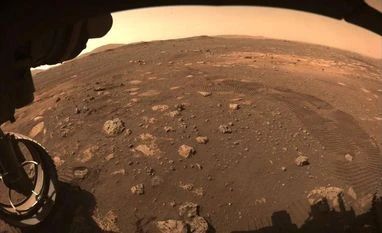 "How Mars lost its water: Study links atmosphere change to methane formation")


 Connect with us on WhatsApp