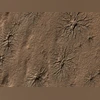
The scientists at the National Aeronautics and Space Administration (Nasa) have recreated the ubiquitous creepy black 'spiders' on the surface of Mars. This was the breakthrough moment for all the scientists as they can now further unveil the secrets of the mysterious structures on the red planet.
These geological features, called araneiform terrain, can be seen at multiple locations on the Red Planet and are given the name 'Spiders on Mars'. There are hundreds of dark crack-like structures that appear on the surface of the planet with hundreds of lines or 'legs'. The tightly grouped deformations can stretch to the lengths of over 3,300 feet (1,000 meters), and look like a hoard of spiders scurrying across the Martian landscape when viewed from space.
These ‘spiders’ were first spotted by Mars orbiters in 2003 which was a complete mystery at the beginning, but later it was found that these structures form when carbon dioxide (CO2) ice on the planet's surface suddenly sublimates or turns the gas first melting into liquid.
Recently a study was published in The Planetary Science Journal where researchers mimicked this process on a smaller scale using a specialised laboratory chamber creating a nearly perfect miniature version of the spiders.
The study was led by Lauren Mc Keown, a planetary geomorphologist at Nasa's Jet Propulsion Laboratory (JPL) in California who has been recreating these spiders for over five years, and the moment of finally birthing the Martian critters was almost too much to handle, writes Space.com.
While issuing a statement, Mc Keown said, "It was late on a Friday evening [when the experiment succeeded] and the lab manager burst in after hearing me shrieking."
"She thought there had been an accident," Keown added.
In another study, the Kieffer model test by recreating these steps in a wide barrel-size chamber at JPL, which is known as the Dirty Under-vacuum Simulation Testbed for Icy Environments (DUSTIE), which recreated Mars's extremely low-ore and temperature -- minus 301 degrees Fahrenheit (minus 185 degrees Celsius).
While doing the experiment, they simulated Martian soil into the chamber and covered it with CO2 ice. They then heated the mixture with a lamp placed beneath the simulated soil replicating the warming effect of the sun.
NASA representative shared a statement that reads, "It took many tries before Mc Keown found just the right conditions for the ice to become thick and translucent enough for the experiments to work." But finally, the ice cracked open and gas seeped out of the holder around 10 min before the frozen CO2 disappeared and left one of the iconic spiders.
A new study reveals a hidden step in the Kieffer model: Ice also formed within the ground causing it to crack open along with the ice. It could explain why spider's legs have such a zig-zag shape, the researchers said.
Serina Diniega, a planetary scientist at JPL, who co-authored the study, issued a statement that reads, "It's one of those details that show that nature is a little messier than the textbook image."
More research is planned into the mystery of these Martian spiders to find out why they form in some places on Mars but not others and why they don't seem to grow in numbers every year, adds the report by Space.com.

 "'Spiders on Mars' fully awakened on Earth; scientists at Nasa excited")


