Former Bangladesh prime minister and Bangladesh Nationalist Party (BNP) Chairperson
Khaleda Zia died on Tuesday after a prolonged illness. She was 80.
Zia, who was Bangladesh’s first female prime minister, was instrumental in restoring a parliamentary form of government and introducing a caretaker government system to oversee free and fair elections.
Early life
Born in 1945 in Jalpaiguri under Bengal Province of British India (now West Bengal),
Khaleda Zia studied at Dinajpur Missionary School and completed her matriculation from Dinajpur Girls’ School in 1960. Her father, Iskandar Mazumder, was a businessman, while her mother, Tayeba, was a homemaker. She was the second among three sisters and two brothers.
How did Khaleda Zia enter politics?
After the Liberation War of 1971, Ziaur Rahman gradually emerged as a central political figure. Following a series of coups and counter-coups after the 1975 assassination of Sheikh Mujibur Rahman, Ziaur Rahman consolidated power and formally entered politics, first as chief martial law administrator and later as president after a referendum in 1977.
Seeking to civilianise his rule, he founded the Bangladesh Nationalist Party (BNP) in 1978, positioning it around Bangladeshi nationalism, political pluralism and a more explicit role for religion in public life, in contrast to the Awami League’s secular policy.
Ziaur Rahman’s rule ended abruptly on May 30, 1981, when he was assassinated during an attempted military coup in Chattogram. The killing plunged the BNP into turmoil and left a leadership vacuum at a time when Bangladesh was again sliding towards military domination.
This led to Khaleda Zia's entry into politics. Until then, she had lived largely outside public life and had no political background of her own. Widowed at 35, she was drawn into the BNP amid appeals from party leaders who saw her as a unifying figure capable of preserving Ziaur Rahman’s legacy and holding the party together against military rule.
Khaleda formally joined the BNP in the early 1980s and rose rapidly through its ranks. She was appointed vice-president in January 1984 and became chairperson in May the same year, taking charge of a party still reeling from internal divisions and state pressure.
Under her leadership, the BNP regrouped as a key opposition force and formed a seven-party alliance to challenge the military regime of General Hussain Muhammad Ershad, who had seized power in 1982. Khaleda emerged as one of the most prominent faces of the anti-Ershad movement, mobilising street protests, hartals and political alliances demanding the restoration of democracy.
ALSO READ | After Khaleda Zia's death, spotlight turns to son Tarique ahead of polls Khaleda Zia's terms as prime minister
Khaleda Zia was sworn in as prime minister on March 20, 1991 after the BNP won parliamentary elections that followed the fall of Ershad's military rule. The vote marked the restoration of parliamentary democracy after years of army-backed rule.
Zia's party saw a landslide win in the 1996 election, though the polls were boycotted by major opposition parties, including Sheikh Hasina's Awami League. Her government lasted only 12 days as before a caretaker government took over to conduct fresh elections, in which Awami League won majority.
Khaleda Zia returned to power for a third term on October 10, 2001.
Legal troubles and later years
Following the installation of an army-backed caretaker government in 2007, Khaleda Zia was jailed along with several political leaders, including her rival and Awami League chief Sheikh Hasina. She was later released and contested the 2008 election, which the BNP lost.
The BNP boycotted the 2014 parliamentary polls, marking the first time since 1991 that the party and Khaleda Zia were absent from parliament.
On February 8, 2018, she was sentenced to five years in prison in the Zia Orphanage Trust corruption case. The sentence was later increased to 10 years, and she was also convicted in another corruption case.
During the Covid-19 pandemic, the Awami League government granted her temporary release on March 25, 2020, under an executive order, suspending her sentence on the condition that she remain at her residence and not travel abroad.
On August 6 this year, President Mohammed Shahabuddin granted her full exemption from the sentence under Article 49 of the Constitution, effectively freeing her.
Khaleda Zia’s death marks the end of a defining chapter in Bangladesh’s political history, shaped by rivalry, reform, and repeated confrontations with power.

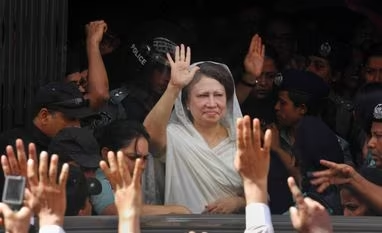 "Khaleda Zia: From political widow to Bangladesh's 1st woman prime minister")


