Pixxel, Dhruva Space launch satellites on SpaceX Falcon-9 from California
launch of three Firefly satellites of Pixxel marked the completion of the first phase of the start-up's constellation of six hyperspectral satellites that would have a clearer look at the Earth
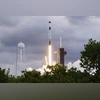
Press Trust of India New Delhi Two start-ups Pixxel Space and Dhruva Space launched satellites successfully onboard SpaceX's Falcon-9 rocket on Wednesday from Vandenberg Space Force Base in California.
The launch of three Firefly satellites of Pixxel marked the completion of the first phase of the start-up's constellation of six hyperspectral satellites that would have a closer and clearer look at the Earth.
"All 3 Fireflies successfully deployed," Awais Ahmed, founder and CEO of Bengaluru-based Pixxel Space said in a post on X. Pixxel had launched three Firefly satellites in January this year.
Hyderabad-based Dhruva Space is also launching its first commercial LEAP-01 satellite carrying payloads from Australia-based Akula Tech and Esper Satellites.
LEAP-01 is the first hosted payload mission carried out by DhruvaSpace for two Australian firms.
"Our earlier launches showed what was possible; this one shows what's next. Expanding to six Fireflies will transform hyperspectral imaging from isolated snapshots into a continuous planetary memory," Ahmed said.
He said with six Fireflies in orbit, the planet itself becomes a living laboratory.
"What was once invisible is now measurable, and what is measurable can finally be changed. For a better world for all to come," Ahmed said.
The Bengaluru-based start-up is now focussing on its next mission to launch a constellation of Honeybee satellites to scan the Earth using the short wave infrared (SWIR) band.
"While there are multiple other satellites in the works, the upcoming Honeybees are special because they will take us further into the electro-magnetic spectrum, enhancing hyperspectral capabilities and increasing the number of use cases we can target," Kshitij Khandelwal, co-founder and CTO of Pixxel Space said.
Operating as a constellation, the Fireflies collectively form the most advanced commercial hyperspectral imaging system ever deployed, a company statement said.
Each satellite can capture more than 135 spectral bands at a five-metre resolution across a 40-kilometre swath, enabling scientists, businesses and governments to detect changes in the Earth's ecosystems with unmatched accuracy.
Dhruva Space Leap-1 mission comprises launching Akula Tech's space-ready AI model optimisation technology that allows optimisation and compression of any Geospatial AI/ML models to run efficiently on the edge in space.
(Only the headline and picture of this report may have been reworked by the Business Standard staff; the rest of the content is auto-generated from a syndicated feed.)


 "Pixxel, Dhruva Space launch satellites on SpaceX Falcon-9 from California")

