
Taiwan has no plans to retaliate against US tariffs, says President Lai
Lai acknowledged the significant impact the tariff could have on Taiwan's economy but reassured the public, emphasising the country's strong economic fundamentals
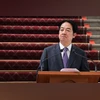 "Taiwan has no plans to retaliate against US tariffs, says President Lai")
Explore Business Standard

Associate Sponsors
Co-sponsor
Lai acknowledged the significant impact the tariff could have on Taiwan's economy but reassured the public, emphasising the country's strong economic fundamentals
Taiwan has no intention of retaliating against the 32 per cent tariff imposed by US President Donald Trump on Taiwanese goods, President Lai Ching-te said on Sunday, according to a report by Focus Taiwan.
Lai acknowledged the significant impact the tariff could have on Taiwan's economy but reassured the public, emphasising the country's strong economic fundamentals.
He pointed out that while 23.4 percent of Taiwan's exports were sent to the US in 2024, more than 75 per cent were directed to other markets. He also highlighted that 65.4 per cent of the goods exported to the US were competitive ICT products and electronic components, indicating the resilience of Taiwan's economy.
While addressing the nation, Lai said, "Taiwan has no plans to take retaliatory tariff action in response to the United States' reciprocal tariffs. Investments by Taiwanese companies in the US will also proceed without any changes, as long as they align with our national interests," Lai said, according to Focus Taiwan.
To reduce the effects of the tariffs, Lai announced that his government has established a negotiation team, headed by Vice Premier Cheng Li-chiun, to begin discussions with the United States.
"The tariff negotiations can start with a goal of 'zero tariffs,' modeled after the USMCA (United States-Mexico-Canada Agreement)," Lai further said.
Domestically, Lai said the government will support industries most affected by the new tariffs, especially traditional and small and medium-sized enterprises (SMEs), accelerate industrial transformation, and leverage Taiwan's strengths in semiconductors and smart manufacturing to position the country as a leader in artificial intelligence applications, Focus Taiwan reported.
On April 2, Trump announced tariffs on countries worldwide. In February, soon after taking charge for the second time, Trump outlined a new trade policy focused on fairness and reciprocity and said that the US would implement reciprocal tariffs, charging other countries the same tariffs they impose on American goods.
Trump emphasised that tariffs would address unfair trade practices, including non-monetary barriers, subsidies, and VAT systems, while encouraging foreign countries to either reduce or eliminate tariffs against the US.
As per the announcements, the import tariffs on other major countries are China (34 per cent), the European Union (20 per cent), Vietnam (46 per cent), Taiwan (32 per cent), Japan (24 per cent), India (26 per cent), the United Kingdom (10 per cent), Bangladesh (37 per cent), Pakistan (29 per cent), Sri Lanka (44 per cent), and Israel (17 per cent).
From April 9 onwards, countries with the largest trade deficits with the US will face higher, individualised tariffs. India is one of the countries affected, with a 26 per cent tariff imposed on all its exports.
(Only the headline and picture of this report may have been reworked by the Business Standard staff; the rest of the content is auto-generated from a syndicated feed.)
First Published: Apr 07 2025 | 7:21 AM IST

