Taiwan will have a 'special channel' meet with the United States administration amid Trump tariffs and growing tensions between China and US, as well as China and Taiwan
3 min read Last Updated : Apr 05 2025 | 4:49 PM IST
Taiwan’s National Security Council chief, Joseph Wu, has arrived in the United States for high-level discussions with President Donald Trump’s administration, Financial Times reported, citing sources familiar with the matter. His visit comes just days after mainland China concluded military exercises around Taiwan, intensifying regional tensions.
Wu is leading a delegation for a meeting under the “special channel,” marking Trump’s first use of this diplomatic avenue since returning to office on January 20. Special channel meets are usually a discreet, unofficial, or informal method of communication between governments, often are typically used to discuss sensitive issues outside of formal diplomatic settings.
Taiwan's strategic importance in US-China relations remains significant as disputes over trade, human rights, and security continue to strain ties.
China conducts military drills near Taiwan
Earlier this week, the People’s Liberation Army (PLA) conducted two-day military drills in the East China Sea, including long-range, live-fire exercises near Taiwan. Both Taiwan and the United States strongly condemned the manoeuvres, calling them a provocation that threatens regional stability.
China, which claims Taiwan as its territory and has never ruled out the use of force for reunification, has escalated its rhetoric against Taiwanese leader William Lai Ching-te. In a fresh move, Beijing labelled Lai a “parasite” following US Defence Secretary Pete Hegseth’s recent visit to Asia, where he openly criticised China’s actions in the region. Lai, who was elected last year, has maintained that Taiwan’s future should be determined solely by its people, a stance that Beijing considers separatist.
While the United States, like most countries, does not formally recognise Taiwan as an independent state, it remains the island’s most significant international supporter and primary arms supplier.
Taiwan not spared from Trump tariffs
Trump’s administration imposed a 32 per cent tariff on Taiwanese imports. While this is slightly lower than the 36 per cent tariff imposed on Chinese imports, it places Taiwan among the more heavily taxed nations trading with the United States. Taiwan has expressed strong opposition to the move, calling it unreasonable.
Despite this, Taiwan has refrained from imposing retaliatory tariffs on US imports, opting instead to engage in diplomatic efforts to mitigate the economic fallout.
The new tariffs have significantly affected Taiwan’s electronics and steel industries, with the government announcing a T$88 billion (($2.67 billion) financial aid package to support affected businesses. Premier Cho Jung-tai, on Friday, also stated that Taiwan’s Office of Trade Negotiations has been tasked with engaging Washington to seek relief from the tariffs. Finance Minister Chuang Tsui-yun further added that the government will provide interest rate reductions on loans for exporters, amounting to T$200 billion, to ease financial pressures.
The trade dispute adds to the complexity of US-Taiwan relations. Trump has been vocal about his dissatisfaction with Taiwan’s semiconductor industry, arguing that it has drawn key manufacturing business away from the United States. However, Taiwan remains a critical partner for Washington, as the island relies on US diplomatic and military support against increasing pressure from Beijing.
The White House and Taiwan’s de facto embassy in Washington, the Taipei Economic and Cultural Representative Office, have yet to comment on Wu’s visit or the ongoing trade discussions.

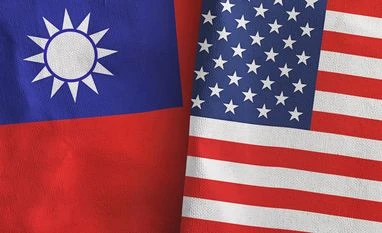 "Taiwan's security chief to meet Trump admin amid US-China tensions, tariffs")


