


An anatomy of financial sector reform
The Budget speech of 1991 changed the tone of reforms, but in the decades since, the pace has been more driven by scams and crises than by necessity, argues Rajrishi Singhal in his book
 "Book")
premium
5 min read Last Updated : Feb 21 2024 | 10:10 PM IST
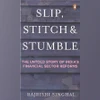
Slip, Stitch and Stumble: The Untold Story of India’s Financial Sector Reforms
Author: Rajrishi Singhal
Publisher: Penguin Business
Pages: 304
Price: Rs 699
When one sees the word “untold” in the title, one would think that this would be some sort of a scoop if it is sensational, or a serious piece of research from classified and archival papers if it is sober. To that extent, the book overpromises and under-delivers. It is a retold story of India’s financial sector reforms.
Rajrishi Singhal is meticulous and organised in his approach to the chronicle. Where there are all-encompassing chapters that set the tone and the direction of how the financial sector is moving, there are also chapters that look at specific and significant sectors — equity markets, co-operative banks, non-bank finance companies (NBFCs), commercial banks and the thematic issue of non-performing assets. He touches on some related sectors — mutual funds and insurance — but does not delve deep into them. Nevertheless, the book is interestingly organised and well-written and gives us the story of reform objectively.
The book uses the Budget speech of 1991 and the announcement of reforms as the pivot point that fundamentally changed the tone of financial sector reforms. Yes, it changed both the tone and the pace of financial sector reforms as a trigger point, but it did not dictate the pace of the reforms. The pace was dictated largely by scams and scandals rather than the urgency and need for reform. The difference between before and after 1991 was that in the pre-liberalisation era, when scams occurred — the Nagarwala, Dalmia and the Mundhra scandals — they did not result in any significant systemic change. They were seen as episodic events that needed to be dealt with as a law and order problem, whereas most of the post-1991 scams resulted in introspection about systemic structures and their relevance. This is the insight we get from the book, even though Mr Singhal does not explicitly say so.
There are two documents on which the road map for reform was laid out in India. The first was the Narasimham Committee that talked about the financial sector and the second was the leaked “M Document”, purportedly written by Montek Singh Ahluwalia, which laid out the road map for overall economic reform (there is a third, the Second Narasimham Committee report, which is not discussed in detail). More than three decades after the two documents were framed, we still find parts of them relevant because many of the issues they suggested have not been acted on. To that extent, Mr Singhal’s title Slip, Stitch and Stumble is justified — that our reform process has been a series of responses to one crisis or the other.
While it is possible to argue that the pace of the reform was not fast enough, given that we are still grappling with clauses laid out in the 1990s, it is also necessary to agree that the direction of reform has been unidirectional and has not generally slipped back. There is reluctance to disinvest and privatise state-owned enterprises, but at the same time there is privatisation of the markets by opening up the space for new players.
We certainly need to ask the question on whether this reform was actually reform at all or an evolutionary process of the Indian financial sector to the changing ecosystem. Was it premeditated or involuntary? It appears that wherever the state was actively involved, the reform process has followed the dual approach of holding on to the state-owned enterprises on an ex-ante basis, while making the larger ecosystem market-facing — what we could call reform by stealth. When the state was in regulatory mode, the reform process was different — the Securities and Exchange Board of India, setting up the National Stock Exchange, and depositories being examples.
Look at the reform of the banking sector. The reform has occurred largely in private sector banking by opening up the space for new licences. Public sector banks continue under the vice-like grip of the state — even as they are listed. Neither has the basic first step of repealing the Bank Nationalisation Act and registering state-owned banks as companies under the Companies Act been done, nor have these institutions been brought under the same regulatory powers of the Reserve Bank of India. While the RBI can take precipitative action such as removing the CEO and superseding the board in the case of a private bank, that is not the case with state-owned banks.
In one sense, the changes in the banking sector are largely aligned with our international commitments to Basel norms and anti-money laundering treaties. But fundamental changes in the governance and management of state-owned banks are yet to occur. It’s a similar case with the insurance sector. While privatisation by stealth did not take place, with narrow banks such as the regional rural banks, the state simply resorted to wielding the sledgehammer of compulsory consolidation!
Mr Singhal’s writing brings these issues out in the open. He covers each one of the major scandals and looks at the impact that they have had on systemic reform — from the US-64, to Harshad Mehta to Ketan Parekh. It is refreshing to see an entire chapter devoted to cooperative banks, a topic that is not discussed much, and on how NBFC reforms were triggered by the CRB Scam.
This is a welcome book largely for how it is organised and the questions it raises. I would, however, be cautious in endorsing its claim to untold facts and a fundamentally new interpretation of the reform process.
The reviewer is faculty member, Centre for Public Policy, IIM, Bangalore. mssriram@pm.me