


Cyrus Mistry's ouster was Tata's biggest regret, says Thomas Mathew
Lunch with BS: "After Chandra took over as Tata Sons chairman, RNT would often say that there won't be noise anymore; there will be stability, there will be growth," says author of Ratan Tata: A Life
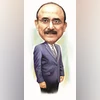 "Thomas Mathew (Illustration: Binay Sinha)")
premium
Thomas Mathew (Illustration: Binay Sinha)
8 min read Last Updated : Feb 21 2025 | 10:25 PM IST


Listen to This Article
We are on neutral ground, having chosen a non-Tata Group hotel for this meeting. For a change, the choice is mine and not that of my guest. Thomas Mathew, the author of the much-talked-about book Ratan Tata: A Life, released just days after the Tata patriarch passed away in October 2024, sits across the table from me at the Spice Route restaurant in the Imperial Hotel, New Delhi. We’ve opted to sit outside, where natural light and space make for a perfect setting. The mild February sun adds to the charm of an outdoor lunch.
As its name suggests, Spice Route offers a medley of cuisines from Indonesia to Vietnam, with dishes from Kerala interspersed in between. My mind is buzzing with questions about Ratan Tata — the man, his life, his thoughts on succession, the boardroom ousting of former Tata Sons chairman Cyrus Mistry, and his half-brother Noel Tata. Mathew, a seasoned bureaucrat who has worked across key ministries and served in Rashtrapati Bhavan under Pranab Mukherjee, then president, is prepared to take on every question.
“Shoot,” he says to me as soon as he’s answered my first question. But before all of that I ask him what he’ll drink. Lime soda with salt — no sugar, as he’s trying to shed weight. I settle for a ginger ale, and then start from the start: When did Mathew first meet Ratan Tata (whom he, like many others, refers to as RNT), and when did he begin working on the biography?
Their first meeting dates back three decades, to 1995, when Tata had approached him regarding a business matter. At the time, Mathew was private secretary to K Karunakaran, then Union industry minister, during Prime Minister Narasimha Rao’s tenure. Over the years, they stayed in touch, meeting on multiple occasions. I’m curious whether it was hard to get appointments with him for the book. “I could walk in,’’ he says. The work on Ratan Tata: A Life began around 2018 — two years after Tata Sons removed Mistry as chairman.
I ask the retired 1983-batch Kerala cadre IAS officer about his conversations with RNT regarding the Mistry episode. “It burned him from inside… His health declined rapidly after that…. He told me that the episode consumed his entire being,’’ Mathew says, holding his glass of lime soda. “That was his biggest regret in life. He would say that’s not the Tata way of doing things ... but he had little choice.”
We turn our attention to the menu and order Kerala scallops as an appetiser. As we wait, our conversation returns to Ratan Tata — his lonely childhood, his role as Tata Sons chairman, his leadership of Tata Trusts, and the different phases of his life captured in the book. Looking for insights beyond what’s written, I ask Mathew about RNT’s views on succession in the Tata empire.
“He had 100 per cent confidence in Chandra (N Chandrasekaran, chairman of Tata Sons). After Chandra took over, RNT would often say, ‘There won’t be noise anymore; there will be stability; there will be growth, and that there’s no better maestro in the Tata Group than Chandra.’’
The Kerala scallops arrive — seasoned with spices, coriander sauce, cumin, lime yogurt, and burned chilli tomatoes. The dish disappears quickly, and we move on to ordering the main course to avoid interruptions in our conversation. I ask Mathew to choose between Kerala cuisine and the Southeast Asian spread. He opts for the latter, preferring to experiment with tom cang kho and gindara miso cod.
While waiting for our meal, I revisit the succession topic from a different angle. What was Ratan Tata’s idea of a successor at Tata Trusts? Did he discuss with Mathew if he wanted Noel Tata to succeed him? How important is the Tata name when it comes to heading Tata Trusts, which controls 66 per cent in Tata Sons, the holding company of the salt-to-software group that has a revenue of more than $165 billion?
“The way I understood it, RNT wanted the organisation to be run professionally,” he replies, pensively. “If it's a Tata, it’s a Tata, if it’s another person who’s equally competent, then it’s him.” For him, Mathew says passionately, Tata as an organisation did not belong to any community or religion; it belonged to the country, and anybody could be chairperson.
For RNT, it was important to remember that all his ancestors had given their funds to Tata Trusts with one primary goal — philanthropy, Mathew explains. Specifically on whether RNT wanted Noel Tata to succeed him, he says, “You have to take the name out of the person first, and the person out of the name. RNT wanted somebody (as chairman of Tata Trusts) to symbolise the ethos and values of the Tata Group.’’ And, Noel Tata symbolises that ethos enshrined in the Tata family, he says. “They are the same blood, and the values are the same… Noel also has the Tata Trusts goal of philanthropy in his mind.’’
As we discuss RNT’s love for American fast food, the simple furniture in his home, and his famously reserved nature, our main course arrives. I savour the miso cod, a Japanese seafood dish with a melt-in-the-mouth texture, while Mathew enjoys tom cang kho, a stir-fried jumbo prawn dish cooked with peppercorns. The two mystery numbers, which we’ve ordered rather blindly, don’t disappoint.
I then ask about another mystery — Ratan Tata’s will. Was he surprised when the will revealed the name of Mohini Mohan Dutta, an entrepreneur from Jamshedpur, as a beneficiary who could get more than ₹350 crore from RNT’s estate? Mathew says the will evolved over time. “I did not question him much on his will as it’s a very personal thing to a man…. He did say that 90 per cent will go to charity, and it has.’’ I ask him pointedly if he was aware of the names (in the will) that are emerging now. “Of course I knew!’’
We change the subject. What about RNT’s close aides, like Shantanu Naidu? “All I would say is that someone like Ratan Tata should have had a chief of staff who could offer mature advice,” Mathew remarks.
We debate whether to order dessert, and finally decide to share a chia seed pudding made with coconut milk and dry fruits. Now, it’s Mathew’s turn to ask me a question: “What do you think of my book? Be honest and critical.”
I respond: “It’s informative, engaging, and entertaining.” My critique? The book could have been more critical, especially regarding the circumstances of Cyrus Mistry’s ouster. Mathew defends his approach, citing international examples of top executives being dismissed without notice.
Returning to the Tata empire, I ask if there’s a chance it could become a family-run business in the future. Mathew reminds me of the clear separation of powers between Tata Sons and Tata Trusts. “The same person cannot be the chairman of both. Tata Sons amended its articles of association in 2022 to ensure that.” But could that clause be changed again? “That would be very difficult, given the checks and balances in place,” he says. As a corporate board member himself, he speaks with authority.
I find the pudding delightful — the coconut milk’s soothing flavour is a perfect contrast to the spices. Mathew takes a small bite, and orders another lime soda with salt. I ask if other business houses or industrialists have approached him for biographies. “Yes,” he replies. Any Tata rivals? He doesn’t disclose names but mentions receiving a congratulatory call from Kokilaben
Ambani (whom he calls ‘Amma’) after the book’s release.
Now that both RNT and Mistry have passed away, and Noel Tata — who has familial ties to the Shapoorji Pallonji group — is chairman of Tata Trusts, could the two families reconcile? Will the bitterness fade? Mathew refuses to speculate. On Noel Tata’s leadership, he simply says, “He is a unifying force. There’s no one better suited to lead the Trusts.”
The afternoon light has shifted, marking the passage of time. We’ve been here for over two hours. Have I found answers to all my questions? Perhaps not, but Mathew has taken them all in his stride. Will his planned unabridged version of Ratan Tata’s life reveal more? That question hangs in the air as we part ways, hoping to continue the conversation another day.
Topics : Cyrus Mistry Tata group Ratan Tata Tata Sons