


Israel-Hamas war: Will govt let OMCs bear burden if oil prices escalate?
While Israel and Palestine are not the major oil players, prices of crude could escalate if the fight drags other nations of the Arab world, as well as the US, into it
 "Fire, smoke, airstrike, rockets, Israel- Palestine, Gaza, Hamas")
premium
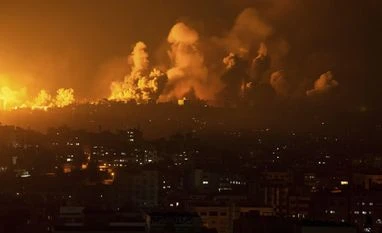
Fire and smoke rise following an Israeli airstrike, in Gaza City, Sunday, Oct. 8, 2023. | Photo: AP/PTI
7 min read Last Updated : Oct 10 2023 | 9:01 PM IST
Global crude prices eased on Tuesday after rallying up the previous day, lending uncertainty to the rates.While subdued demand worldwide may not allow prices to escalate much despite production cuts by the oil-producing countries, the Israel-Hamas war can potentially drive it up if it escalates to other areas in the Arab world.
The average monthly price of an Indian oil basket eased to $89.49 a barrel in October (till 9th) from $93.54 in September. However, it rose from $85.66 a barrel on Friday to $88.10 a barrel on Monday. Monthwise, it had peaked in September so far this financial year.
However, the coming days are full of uncertainties. While Israel and Palestine are not the major oil players, prices of crude could escalate if the fight drags other nations of the Arab world, as well as the US, into it. Monday saw oil prices surging by over four per cent as a reaction to the conflict. However, the rates eased on Tuesday while traders remained cautious over potentail supply disruptions amid West Asia conflict, Reuters reported.
According to a Bank of Baroda note, if the conflict ends in the next few days, there will be repercussions on the stock, bond and currency markets.
However, if the war persists for long beyond a fortnight, the oil dynamics will change.
It said Brent had crossed the $90 mark but then retreated. Now, the 90 number can be used as the benchmark beyond which there is trouble for the world economy.
Oil minister Hardeep Singh Puri said on Monday, "The place where the action is taking place is in many respects the centre of global energy... as we go along, we will navigate through this."
However, the three state-owned oil marketing companies (OMCs) -- Indian Oil Corporation Ltd (IOCL), Bharat Petroleum Corporation Ltd (BPCL) and Hindustan Petroleum Corporation Limited (HPCL) -- have not raised the retail prices of petrol and diesel since May 22, 2022 when the Centre had cut excise duty on petrol and diesel and some states lowered value added tax on them. However, they resorted to raising the liquefied petroleum gas (LPG) prices by Rs 209 per commercial cylinder of 19 kg earlier this month. They also raised prices of aviation turbine fuel (ATF) by five per cent earlier this month, the fourth monthly increase since July in a row.
On the other hand, prices were cut by Rs 200 per domestic LPG cylinder in late August. The government also announced another cut of Rs 100 for Ujjwala beneficiaries of LPG cylinders earlier this month.
The retail price of petrol stands at Rs 96.72 a litre in Delhi and over Rs 100 in the other three metros -- Mumbai, Chennai and Kolkata. That for diesel stands at Rs 89.62 a litre in Delhi and over Rs 90 in rest of the metros.
The oil marketing companies may not raise these retail prices given the upcoming assembly elections in November and December to be followed by the general elections a few months after oil prices have been theoretically deregulated.
But how long? Will the oil marketing companies absorb losses, or would the Centre cut the excise duty or give the companies a one-time grant like in 2022?
According to a recent report by Moody's Investors Service, high crude oil prices will weaken the profitability of the three oil marketing companies in India. According to the report, the three companies will have limited flexibility to pass on higher raw material costs by increasing the retail selling prices of petrol and diesel in the current fiscal year because of upcoming (general) elections in May 2024.
The report further says the profitability of these companies will weaken as feedstock costs rise and selling prices remain unchanged. The three companies' earnings will stay strong and higher than historical levels during the current financial year, even if crude oil prices stay at current levels of $85-90 a barrel in the second half of the year, the report estimates.
"We estimate that the OMCs will start incurring EBITDA losses in the second half of the current financial year if crude oil prices increase to around $100 a barrel. Nonetheless, we believe high oil prices are unlikely to be sustained for long as global growth weakens," the report says.
The other option could be the government cutting excise duty on petrol and diesel. However, before devolution to the states, union excise duty collections fell over 12 per cent at a shade below Rs 1 trillion in the first five months this financial year as against Rs 1.1 trillion in the corresponding period of the previous financial year. Union excise duty is now imposed on only petroleum and tobacco.
However, the government may still cut the duty as collections from other heads of taxes are buoyant.
The total tax kitty, excluding Union excise duty, rose 20.16 per cent at Rs 10.9 trillion in the first five months this financial year as against Rs 9.1 trillion a year ago.
The Monetary Policy Committee of the Reserve Bank of India (RBI) has retained the projection of retail price inflation at 5.4 per cent for the current financial year while slightly changing quarterly forecasts. The projection is based on the assumption of $85 a barrel. If the global prices of the Indian oil basket averaged more than this, inflation may rise beyond RBI expectations.
While raising the retail prices is ruled out due to upcoming elections, if the government cuts excise duty and lowers retail prices on petrol, diesel and other fuels by the same proportion, this may not help OMCs.
Vivek Kumar, the economist at QuantEco Research, says since PSU oil companies are government-owned entities, from an economic point of view, it does not matter who among them bears the cost of keeping consumers insulated.
"The cost can show up in various forms like forgone tax, dividend revenue by government, higher subsidy payment by government or lower capex by oil companies," he points out.
Bank of Baroda chief economist Madan Sabnavis says the options are to share the burden between the OMCs and the government.
"The OMCs gained a lot when crude prices went down and retail prices were unchanged. For the next few months I would tend to believe that the OMCs will bear the cost. The government may review the state of fiscal position towards the end of 2023 and take a call on excise in case global prices keep increasing or remain elevated over the $90 mark," he opines.
Anil K Sood, professor at the Institute for Advanced Studies in Complex Choices (IASCC), says the government can indeed reduce the excise duty and lower the prices for end consumer, but that would impact its fiscal balance.
"Reducing excise duty would be the most transparent way to help households manage their budget, particularly at a time when food inflation is high and transportation cost constitutes more than 16 per cent of household consumption expenditure," he points out.
However, the government will likely nudge the oil marketing companies to absorb the losses and give them one grant later, if required, he says on the options available.
"The government had used this approach during 2022. Given that the Indian consumer is used to petrol and diesel being priced around Rs 100 per litre, the oil companies earn super-normal profits when the crude prices fall, allowing them to recover the losses they make during the election season," he explains.
Such an approach reduces the need for bringing subsidies into the central government budget, particularly in situations where oil prices don't remain high over a long period of time, he says.