Tuesday, January 06, 2026 | 01:14 AM ISTहिंदी में पढें
Business Standard
Notification Icon
userprofile IconSearch

Statsguru: Are Indian tariffs truly 'top of the pack' as Trump claims?

Does India charge more than its peers in world trade?
Modi, Narendra Modi, Donald Trump, Trump
premium

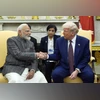
President Donald Trump meets with India's Prime Minister Narendra Modi in the Oval Office of the White House, Thursday, Feb. 13, 2025, in Washington. (Photo: PTI)

Yash Kumar Singhal New Delhi

Listen to This Article

US President Donald Trump recently unveiled his plans to impose ‘reciprocal tariffs’ on all trading partners, including India, to narrow his country’s ‘persistent’ annual trade deficit in goods. Trump termed India as a nation which is “right at the top of the pack” when it comes to tariffs. In a joint press conference with Prime Minister Narendra Modi, he said India would face reciprocal tariffs, while acknowledging the country’s attempts in its recent Union Budget to reduce duties on motorcycles above 1,600 cc (benefitting Harley Davidson motorcycles). This warrants a question: Does India charge more than its peers in world trade?
 
India collected ₹2.33 trillion in Customs duties in 2023-24, which was 6.73 per cent of its total gross central tax collections. Union Budget for 2025-26 projects this share to reduce to 5.62 per cent. However, India had a greater share of revenue from Customs in total tax revenue (7.4 per cent in 2022) than other emerging and advanced economies (Charts 1 and 2). 
 
    The trade-weighted average duty levied by India has increased in recent years. The year 2023 saw such duty rising to 12 per cent, with the highest duty of 379 per cent imposed by India, which also charges roughly twice as much as Brazil. The US levied an average duty of 2.2 per cent in 2023, one-sixth of what India did (Charts 3 and 4).       
 
According to the World Tariff Profiles 2024, a duty of between 5 and 10 per cent was levied on 61.1 per cent of non-agricultural products by India. On the other hand, 76.8 per cent of agricultural products carried a duty between 25 and 50 per cent in 2023, giving more protection to agriculture (Chart 5). 
 
Russia leads the world with the greatest number of tariff lines. India had 12,302 tariff lines in 2023, followed by the US and Brazil (Chart 6).