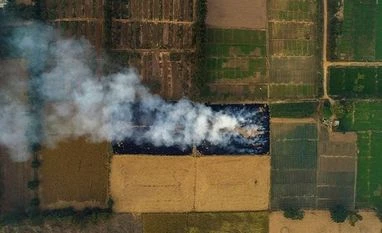
Punjab emerged as the leading emitter, with 27 per cent of its cultivated area subjected to burning in 2020. It was closely followed by Madhya Pradesh, which accounted for 30 per cent of India's total burned area in the same year.
Although efforts by the Centre and state governments have reduced incidents of crop residue burning, particularly during the kharif harvest season since 2021, the practice has not been completely eradicated. States like Haryana have successfully reduced paddy stubble burning through a mix of financial incentives, subsidised machinery, penal provisions, and awareness campaigns.
For the study, IISER collaborated with the International Maize and Wheat Improvement Center (CIMMYT) and researchers from the University of Michigan. They developed satellite-based technology that offers insights into GHGs emitted from the burning of crop residues in India.
Unlike previous assessments, which relied on agreed estimates of burned crop residues, the current study utilised satellite and other forms of data to focus on actual district-level burned areas and associated emissions from 2011 to 2020.
The study indicated that most emissions occur at the end of the kharif season, followed by the rabi season, largely due to the burning of rice and wheat residues. Rice, wheat, and maize accounted for 97 per cent of India's agricultural burning emissions, with rice being the largest contributor at 55 per cent.
Emissions of carbon monoxide (CO) and greenhouse gases, including carbon dioxide (CO2), methane (CH4), and nitrous oxide (N2O), increased by approximately 75 per cent over the decade, rising from about 19,340 gigagrams per year in 2011 to roughly 33,834 gigagrams per year in 2020.
"While initial policy measures led to a decrease in burning during 2014-2015, a surge occurred in 2016, underscoring the need for more effective and sustainable policies," said Monish Deshpande, Research Scholar, Greenhouse Gas Modelling and Applications Group, IISER Bhopal.
Dr Vijesh V. Krishna, a senior economist at CIMMYT, added, "The detailed mapping of these emissions can serve as the foundation for successful policy interventions to control residue burning."


 "stubble burning")