


Home / India News / Nripendra Misra on his PMO days, Ram temple, demonetisation and more
Nripendra Misra on his PMO days, Ram temple, demonetisation and more
Misra has a freewheeling conversation with Nivedita Mookerji & AK Bhattacharya about his days at the PMO, the power structure, demonetisation, the PM's Budget and the Ram temple
 "Nripendra Misra")
premium
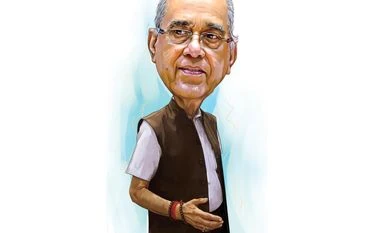
Nripendra Misra: (Illustration: Binay Sinha)
9 min read Last Updated : Aug 17 2023 | 5:03 PM IST
It’s hardly a surprise that our guest has chosen India International Centre (IIC), and not some fancy restaurant, for this lunch meeting. Set by the verdant Lodi Gardens in New Delhi, IIC is a hub for statesmen, policymakers, diplomats and intellectuals, a cultural centre like few others in the country. We arrive ahead of time and head for the lounge where we are scheduled to meet, only to realise that Nripendra Misra, former principal secretary to Prime Minister Narendra Modi, is waiting for us at the IIC Annexe, a seven-odd-minute walk from the main building. Again, no surprise — the 1967 batch Uttar Pradesh cadre IAS officer has for years kept most of his out-of-office meetings at the third-floor Lounge at the Annexe.
Misra, who now wears two hats, as chairman of the Ram Janmabhoomi Trust (Ayodhya) construction committee and executive council chairman of the Prime Ministers’ Museum and Library (formerly called Nehru Memorial Museum and Library, a name many still know it by), says he prefers the relatively quiet Annexe Lounge to the buzzing dining hall.
We plunge straight into the conversation, starting with his big shift from the Prime Minister’s Office (PMO) to Ayodhya. But the bureaucrat in him is looking for order, literally. “Let’s get this out of the way,” Misra says, pointing at the menu card. He orders chana chaat and coffee, both to be brought to the table together. That’s his staple lunch, he confesses, adding he never spends more than 10 minutes over it since his breakfast is “heavy”. Hope this lunch is a bit longer than 10 minutes, we blurt out! “We are here to talk,” he says with a hint of a smile, while recommending grilled fish to us. We like the grilled fish idea but also order something wholly different, raagi masala dosa, sharing a laugh over how this dosa is in sync with the PM’s overarching millet theme.
The order out of the way, Misra, who’s casually dressed, takes up the question on how his current assignment is different from his PMO days (2014 to 2019). “You may call it boring, but I always follow a regulated schedule, allocating time for everything I do,” he says. So, broadly the same method comes handy whatever the assignment, he indicates. At the PMO, he recalls, no meeting stretched beyond an hour. He speaks of the influence former cabinet secretary TSR Subramanian had on him. “He would always say that one has to go to a meeting prepared and know beforehand what decision should be taken.”
Misra, it seems, hasn’t wavered from that neat plan, which ensures crisp meetings ending in decisions or at least a semblance of consensus. Of course, not everything has worked like clockwork. The Goods and Services Tax (GST) is an example of how consensus-building proved tough initially, he recalls, and then how, after many twists and turns, the idea of GST Council’s veto power sealed the deal. While then finance minister Arun Jaitley was at the forefront of the GST initiative, Misra says, “We (he and Jaitley) said in the end that he (PM Modi) is the winner”, given the way the issue was handled to arrive at a consensus. Coming from Gujarat, a manufacturing state, Modi initially had reservations about GST, but over the months he got convinced about its national relevance and efficiency, and owned it.
We move to current issues, including the government’s response to the Manipur violence. Could things have been handled differently and would he have advised the PM in some other way had he been the principal secretary now? Misra’s reply is that of a bureaucrat: “There can be better solutions to every problem”; to the second part of the question, he says, “but I’m in no position to answer as I do not have facts as prevalent on the ground or knowledge of the advice being given to the PM now. I also don’t know if my advice would have been taken.”
The food arrives, and we’re mindful of the 10-minute lunch Misra believes in. It’s a business lunch, we tell ourselves and focus on the talk. The food, however, gives us an opportunity to also ask him about the cuisines and delicacies PM Modi enjoys. Misra laughs, saying he’s not had any one-on-one meal with the PM. That said, he’s known to be a frugal eater, he tells us. At working lunches, “we would wait to see what the PM might eat”. Dhokla, idli and samosa are among the dishes that would have Modi’s interest, he says.
As we chew on that, we are also curious to know about the disappointments Misra might have faced at the PMO. Land acquisition tops the list: “My consultation was inadequate,” he says, while pointing out the significance of meeting people of all kinds, particularly the interest groups, at the PMO as the job is diverse. “I had not assessed the farmers’ mind… I should not have depended only on the agriculture ministry for inputs… Finally, I said, let the Ordinance lapse, surprising the PM.” The third promulgation of the Ordinance would have made the PM unpopular, Misra thinks back. The farmers’ agitation in 2020-21 brought to the fore similar issues, though Misra had stepped down by then.
What is it like to work with PM Modi, really? His goal has been to dismantle the silos ministries and departments work in, we are told. Are the silos gone? “Not totally,” he says. Then, speaking in a measured tone, Misra says any sign of corruption enrages him and cross-conversation at a meeting upsets him. Indicating that we have a hands-on PM, he adds, “He would want to know what policy implementation issues came to me when I was the principal secretary.”
We are almost done with the raagi dosa and the fish. Misra is by now enjoying his regular coffee. We ask for Darjeeling tea, a brew that is known to help one relax and unwind. We, though, are just getting warmed up. So we put the question that has been waiting to be voiced: What are the power equations at the PMO? Who’s more powerful — the principal secretary or the national security advisor (NSA)? The jury may be out on that one but his answer carries a message. “In my time at the PMO, the issue of who’s more powerful never came up. For defence and foreign-related matters, the NSA would obviously spend more time with the PM…. The point to remember, however, is that with this PM, nobody comes out of his room feeling more important.”
The spicy aroma of the Darjeeling tea spreads across the table as we ask the next question: Is it the Prime Minister’s Budget or the Finance Minister’s Budget? “It has to be the PM’s Budget,” is Misra’s quick response. The PM, he says, is obsessed with the common man –their expectation and their empowerment must be addressed in any Budget. Misra qualifies his answer, adding that “it is still a work in progress”.
The tea begins to spin its magic and we ask how he would compare the many PMs he would have worked with in his long bureaucratic career. “I cannot compare the PMs because I have dealt with others when I was at different levels,” says Misra, 78. “The only one I have worked with directly is the current PM.’’ He says he has never seen Modi upset over any election result and that he never blames anybody else for any decision. We ask if there was any regret or a rethink over demonetisation. “There was never a second thought on that,” Misra replies.
As his favourite job so far, Misra lists his stint as the chairman of the Telecom Regulatory Authority of India (Trai), soon after he retired as secretary, Department of Telecommunications. “I was very satisfied there.”
Misra has worked with other ministries and departments, including finance. Any thoughts on why economic reforms have slowed? The question is logical since we are meeting just after the government has announced restrictions on the import of computers and laptops. In many cases, Misra says, the system didn’t allow it (reforms), and disinvestment or separation of land has been a major bottleneck. He agrees that reforms in this government could have been much faster, with no opposition from political parties. So, it might not be incorrect to say that the neta (leader) is not a problem, but bureaucracy is.
Misra is looking at his watch as we move on to the Ram temple. “To my satisfaction, it may get completed on schedule, maybe with a one-month delay.” From a 10-hour workday, he’s now on an eight-hour schedule: 10 am to 6 pm. What’s more, his current role also carries some star quotient: Amitabh Bachchan is doing the voiceover, pro bono, for a special series that will coincide with the inauguration of the temple.
Any plans of writing a memoir, like some of his predecessors at the PMO? “I believe such tenures should not be used to ever write an autobiography or a memoir,” he says. We turn the clock back a bit to discuss some of the earlier principal secretaries: PN Haksar, Brajesh Mishra and TKA Nair. Misra makes a point: “The earlier principal secretaries had kept details with themselves and they were told to deliver. Now, the details are with the PM. He’s in complete control of things.” He explains that whether it’s the Ayushman Bharat scheme or major security policies or even choosing the line drawing of the ‘Gandhi chashma’ for the Swachh Bharat campaign, PM Modi is on top of things.
On a lighter note, we ask him some quick parting questions. The books he reads? Mostly non-fiction and utilitarian. His entertainment? Well, he has no time for OTT, but is a film music buff — only oldies. Rafi or Kishore? Kishore.
With that, we wrap up the conversation that’s lasted some 90 minutes – way over his 10-minute lunch.
The man, who has recently spoken about the relevance of exiting in regard to his resignation as principal secretary in 2019, is evidently focused on the job at hand: building the Ram temple. The government wants the temple to be ready before the high-stakes 2024 election. Misra maintains it’s not a political job; it’s 100 per cent a bureaucratic one. And it has to be done according to his rulebook: allocate time, take decisions and ensure delivery.
Topics : BS Special PMO Prime Minister Office