


Home / India News / US tariffs will not have a major impact on Gujarat, says CM Bhupendra Patel
US tariffs will not have a major impact on Gujarat, says CM Bhupendra Patel
Marking four years in office, the Gujarat CM outlines plans for regional investment summits, industrial growth, Japan partnerships, and support for sectors facing tariff pressures
 "Bhupendra Patel")
premium
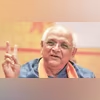
Bhupendra Patel, chief minister (CM) of Gujarat.
8 min read Last Updated : Sep 07 2025 | 11:43 PM IST
Listen to This Article
Bhupendra Patel, who completes four years as chief minister (CM) of Gujarat on September 13, tells Deepak Patel and Archis Mohan in New Delhi about his government’s plans to go regional with the Vibrant Gujarat Summit, efforts to help the state’s industries hit by US tariffs, and the increasing ties with Japan. Edited excerpts:
What are the objectives of the Vibrant Gujarat Regional Conferences (VGRC)? How are you dealing with the challenge of getting investment for underdeveloped districts, such as the predominantly tribal districts?
The state government is organising the regional conferences under the auspices of the Gujarat Global Summit, which was first launched in 2003 by Narendra Modi when he was Gujarat CM. It has now evolved into one of our most important economic forums. The regional conferences in Mehsana, Rajkot, Surat, and Vadodara will provide a focused platform to connect local strengths with global opportunities, unlocking the untapped potential of Tier-II and –III cities. To empower tribal communities, the Gujarat Industrial Development Corporation (GIDC) is planning to establish tribal industrial parks at six locations — in Banaskantha, Dahod, Chhotaudepur, Narmada, Tapi, and Bharuch districts. We hope to change the point of view of the local people, especially their resistance to land acquisition for development projects. “We will not give it (land), we will not allow it” is the refrain. But when they see development happening at district level, they understand that joining the process is the only way forward, and it is through this participation that their own development will also take place. We are preparing ‘District Regional Economic Development Plans and Regional Economic Masterplans’. The NITI Aayog has supported us in this. For example, in the Surat Economic Region, six districts were included and a masterplan was prepared.
Gujarat has attracted significant foreign and domestic investment in recent years. But of late, a few big investors have opted to invest in Maharashtra, Tamil Nadu, and Andhra Pradesh. What is the Gujarat government doing to attract investment, especially into the manufacturing sector?
Gujarat is developing next-generation industrial clusters in sectors such as semiconductors and electronics, precision engineering, renewable energy, aerospace and defence, and emerging technologies. For instance, Micron’s ATMP (assembly, testing, marking, and packaging) facility in Sanand has entered the cleanroom validation stage. The Tata semiconductor fab in Dholera is progressing, with the state proactively enabling supportive infrastructure. We have integrated land allocation, utilities, and regulatory approvals under a single window platform — Investor Facilitation Portal (IFP). Additionally, VGRC will facilitate investor delegations through partner countries and global organisations, ensuring that Gujarat remains a preferred destination for strategic manufacturing investment. But it is important to note that some of these states had not progressed as much. Now, if they want to move ahead, they might say, “Look, Gujarat is offering 25 per cent, so we will offer you 30 per cent.” But Gujarat cannot offer 30 per cent, because that may not be feasible.
What is the next generation of reforms Gujarat is looking at?
The state government’s efforts to improve the ease of doing business include more than 2,900 compliances reduced, timelines of more than 60 approvals/permissions are being reduced, decriminalised above 200 provisions, and additional 500+ provisions are under the process of decriminalisation through the State Jan Vishwas Bill. We have set up three-tier committees for ensuring timely approvals through the Single Window Clearances Act, 2017. We do time-bound redress of grievances and have a single platform for Investment Intention/MoU filing, obtaining business approvals and availing incentives under state policies and schemes. Gujarat is investing in emerging technologies like artificial intelligence, machine learning and robotics, enabling rapid prototyping and early adoption in public services.
We have just introduced the semiconductor policy. We keep reviewing our policies. There is no policy paralysis here.
During his recent visit to Japan, the Prime Minister spoke about tieups between Indian states and Japanese prefectures.
A sister-state agreement between Gujarat and the Shizuoka prefecture and a twinning agreement for friendship and cooperation between Hamamatsu City and Ahmedabad City have been signed. Our focus is on building co-innovation bridges in areas such as mobility and electric vehicles, semiconductors, specialty chemicals, precision machinery, green hydrogen, and clean energy solutions. To support this, we are developing industrial infrastructure, particularly in Sanand and Dholera, and facilitation platforms tailored for Japanese companies. Gujarat’s port infrastructure and operational standards are already aligned with Japanese expectations. Japan has confirmed to be a partner country for the VGRC North Gujarat to be held in Mehsana.
All state governments have supported the rationalisation of goods and services tax (GST) rates, but some have flagged revenue losses to states. What is your view?
For the greater good, one’s individual interests may be affected a little here and there, but that is minor. Financially, we in Gujarat do not face any such difficulty. However, in some other states where the financial situation is already weak, they may feel the impact accordingly.
What are your thoughts on the issue of increasing devolution to the states as some state governments have demanded from the 16th Finance Commission?
When it comes to states, going to the Centre again and again with such expectations is not the right approach. Of course, whenever we need to seek support, we can, but what should our own focus be? Since we are moving ahead with the vision of self-reliance, as India progresses towards becoming a developed nation, we must first strengthen our own states. Our states too must learn to become self-reliant. Just look at the natural calamities — how severe they have been across the country! In such times, who will stand with us? We must be able to stand on our own.
What will be the impact of American tariffs on Gujarat’s exports?
They will not have a major impact — only in two-three sectors. For example, in textile, yes, there will be some effect. But we also have the mindset to stand firm with this. Across the country too, the textile sector faces such challenges. The real question is: What approach should the nation take, and how should we stand together? With the support of industries, this can be addressed collectively.
What steps can be taken at state level?
The state can take steps — such as providing certain promotional support, or relief in areas like electricity duty. We have told industry representatives: Sit together first, identify the challenges you are facing, and then come to us. After that, we can decide what measures we can take together to support you.
When is Dholera airport expected to be completed?
Work on the runway has started, and should be completed by November. In November, both cargo and passenger flights will begin. A new airport is coming up in Ahmedabad. An expressway is being built. An ICT (information communications technology) facility is being developed. Our existing airport here is being fully upgraded, and once the new one is ready, there will be significant benefits.
On September 13, you will complete four years in office. What have been the key achievements so far, and what are your priorities?
Honestly, I have never thought about it, and I usually don’t think in that way. It’s the Honourable Prime Minister who should be credited for all the developments in the state. I have never claimed personal credit, saying “I did this” or “I achieved that”. It’s under the Honourable Prime Minister’s guidance that I move forward. Whatever problems have come up — big or small — we have identified them, addressed them, and resolved them positively. There has never been an issue we couldn’t handle. I have also never reacted negatively to press comments. If something negative appears in the news, I tell my team: Check where we went wrong, correct it, and move forward.
What have been the steps taken in renewable energy?
Now in Gujarat, agricultural demand is entirely supported by renewable energy. Agriculture has been made green, and because of this, delivery costs have come down significantly. Today we are competitive since costs are rising elsewhere while ours have fallen. In one year alone, costs have dropped by six rupees. Earlier, we gave a discount — first 50 paise, followed up by 40, and then 15, and there’s also a 15 per cent tax. Altogether, it comes to about ₹1.25 within a year. This reduction has lowered the operational costs for our people since power is a major component. Similarly, the state has progressed in harnessing solar energy under the PM Surya Ghar Yojana, and rather than just paying bills, people are receiving money — use electricity and still get paid for it.