


PVs in top gear as rural growth back on track; inventory levels decline
OEMs feel consumption in this segment will continue to grow this year
 "Passenger vehicle, cars")
premium
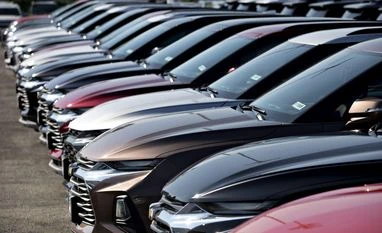
Representative Image | Photo: Bloomberg
4 min read Last Updated : Feb 09 2025 | 11:33 PM IST
Listen to This Article
Rural growth in passenger vehicles (PVs) is back in 2025 with rural retail sales in January clocking an 18.75 per cent growth.
Moreover, with single-digit growth in PV dispatches in January — when overall retail growth was a strong 15.5 per cent year-on-year (Y-o-Y) — the inventory levels of top original equipment manufacturers (OEMs) have come down too.
For example, Maruti Suzuki India (MSIL), the country’s largest PV player, now has only 18-20 days of dealer inventory.
A senior company executive said the rural market saw growth towards January 2025 — rural sales grew by 15.5 per cent last month. Also, for the year-till-date period, rural sales growth has been 11.4 per cent while urban sales remained flat.
Overall, PV retail grew 58.7 per cent month-on-month in January.
Dealers said that part of the surge was due to December purchases being registered in January for a ‘2025 model year’.
“Urban markets inched up from 60.8 per cent to 61.8 per cent share, but rural actually posted a higher Y-o-Y growth of 18.57 per cent versus urban’s 13.72 per cent,” said the Federation of Automobile Dealers Association (Fada).
Fada also highlighted that inventory levels have improved — dropping by around five days to 50-55 days. Last year’s heavy discounting helped clear older models, and inventory levels improved, they said.
Top automotive OEMs, however, told Business Standard that their inventory days with dealers were around 30 days now.
Tata Motors, Mahindra and Mahindra (M&M) and Hyundai Motor India (HMIL) all confirmed that they have about 30 days or four weeks of inventory with their dealers now.
Tarun Garg, whole-time director and chief operating officer (COO) of Hyundai Motor India (HMIL) told Business Standard, “Currently, demand momentum is stable and our dealers have about 4 weeks of inventory. RBI has announced a 25 basis points reduction in interest rates and this augurs well for the overall demand sentiment, going forward.”
For Hyundai, rural contribution has seen consistent growth. “Rural indeed has been the cornerstone of HMIL’s strategy, especially over the last few years. Our rural contribution has seen consistent growth. Also, we are continuously strengthening our rural presence in high potential locations both from sales as well as customer service perspectives,” Garg added.
“Our January 2025 rural growth stood at 7.4 per cent (against January 2024) and April 2024-January 2025 Y-o-Y rural growth was 6.3 per cent,” he said.
In fact, Garg felt that the gap between rural and urban is shrinking with rural customer preferences evolving.
“We believe that rural contribution will continue to improve backed by strong measures focused on improving productivity, supporting minimum support price (MSP) and facilitating government-backed loans to farmers via Kishan Credit Card. Further road infrastructure continues to grow steadily, thus boosting rural demand. The gap between so-called ‘Rural’ and ‘Urban’ is now shrinking and rural customer preferences are evolving at a very high rate,” Garg added.
M&M’s executive director & chief executive officer (CEO) (auto and farm sector) Rajesh Jejurikar said that the company has seen a strong rural revival. And at the same time, urban demand has been ‘very strong’ too.
“So, for us the urban and rural growth rates have been very similar. We know that some other OEMs have seen a faster growth rate in rural than urban. But for us, it seems to indicate that the growth rate is equally split between urban and rural,” he said.
“It’s of course a function of the portfolio that we have, the kind of customers that we are getting and a good dispersion that we have between urban and rural right now. For inventory, we are within our norms and roughly at about 30 days,” Jejurikar said.
As such, OEMs feel that due to the Budget push through tax relief and more money in the hands of consumers, topped by the RBI rate cut, the demand for cars in the ₹10-25 lakh bracket will rise.
In the Q3FY25 analyst call, Shailesh Chandra, managing director (MD), Tata Motors Passenger Vehicles & Tata Passenger Electric Mobility, had said a lot of crowding is going to happen in the greater than ₹18 lakh price point (given competitive intensity in electric vehicles or EVs is increasing).
“But we will have a unique advantage of cars priced less than ₹12 lakh, which are basically city cars, primarily city EVs. This is not where competition intensity is increasing and therefore, we will fully leverage this opportunity to get into even Tier 2 and Tier 3 cities. This includes rural because there is a high propensity of customers going for EVs here,” Chandra had said.