Opening up to the world economy
The first and most important theme was the opening up to the world economy after nearly four decades of an inward-looking development strategy had yielded per capita economic growth at less than 2 per cent since 1950. Absurdly high peak customs tariff rates, ranging up to 300 per cent, were brought down over five years to (a still high) 50 per cent. With the active cooperation of the commerce ministry, almost all the extraordinarily detailed import controls on capital goods, intermediates and raw materials were abolished (those on consumer goods were phased out only by 2001). The rupee was devalued and the opaque, basket-pegged exchange rate system was transitioned into a single, market-determined exchange rate by 1993. The regimes for foreign direct investment (FDI) and technology transfer were significantly liberalised and foreign institutional investors (FIIs) were allowed to invest in the Indian stock market in 1992. The result: Exports grew robustly, capital inflows surged and foreign exchange reserves accumulated to new highs.
The second major theme was the decontrol of industry. On the day in July 1991, when
Manmohan Singh presented his first pathbreaking Budget in Parliament, the industry ministry tabled the New Industrial Policy Resolution. It virtually abolished the stultifying system of comprehensive and detailed licensing of industry, which had prevailed for decades and depressed industrial dynamism and innovation. Spawned by notions of central planning, the system had long outlived its rationale, if it had any in the first place. At the same time, the number of industrial subsectors reserved for the public sector was sharply reduced, paving the way for the rapid growth of private firms in areas such as airlines and telecom. Unsurprisingly, industrial growth in 1992-97 accelerated to nearly 8 per cent. Overall, economic growth averaged nearly 7 per cent for the first time in India’s history.
India’s financial sector, dominated by public sector banks in 1991, had been long repressed by rigid controls on interest rates, preemption of bank resources through high cash reserve ratios (CRR) and statutory liquidity ratios (SLR), which rose to nearly 40 per cent by 1990, detailed credit controls and other regulations of the Reserve Bank of India (RBI). During 1991-96, interest rate controls were lifted, both CRR and SLR were significantly reduced and the first generation of private banks (including ICICI Bank and HDFC Bank) were given licences.
Resurrection of Monetary Policy
Over this period, monetary policy made great strides in shifting from a control-ridden paradigm to something much closer to the modern monetary policy, with the focus on policy interest rates and monetary aggregates. The handicaps imposed by unrestricted borrowing by the central government through ad hoc treasury bills also began to be phased out under a 1994 agreement between the government and the RBI. Concomitantly, Manmohan Singh deliberately nurtured a very substantial increase in the de facto autonomy of the RBI from the finance ministry.
Capital market development
In 1991, the stock market was somewhat like an old-fashioned club, vulnerable to misuse of insider information and other malpractices, as the Harshad Mehta scam of 1992 demonstrated so vividly. Burnt by the backlash, Manmohan Singh launched an array of institutional initiatives, which transformed the Indian capital market into one with much better regulation and state-of-the-art technology with online trading and paperless records. The key new institutions were the Securities and Exchange Board of India (Sebi), the government-sponsored National Stock Exchange (NSE) and the National Securities Depository Limited (NSDL).
There was, of course, much more, such as tax reforms in both direct and indirect taxes and the beginning of taxation of services. But space constrains their elaboration. One area, though, may be worth emphasising: His attention to building and retaining a strong top team of economics-trained officers in the finance ministry and the RBI, including Montek Singh Ahluwalia, C Rangarajan, N K Singh and Y V Reddy. Their expertise, durability and intra-team cohesion helped in the articulation, implementation and projection of Manmohan Singh’s economic reforms programme.
Finally, what may have mattered most is Manmohan Singh’s own unmatched experience in Indian economic policy and administration, his profound wisdom, unusual political acumen and, perhaps, above all, his extraordinary decency and integrity.
The writer is Former Chief Economic Adviser to the Government of India (1993-2001)


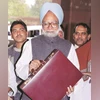 "Manmohan Singh")