What the US is offering are not normal trade deals but Masala deals — Mutually Agreed Settlements Achieved through Leveraged Arm-twisting. These one-sided agreements offer tariff relief only if countries agree to guaranteed US exports and politically useful wins for President Donald Trump, with little regard for fairness or reciprocity.
The story began on April 2, when President Trump stunned the world by announcing new country-specific tariffs on 57 nations — 26 per cent on Indian goods, 20 per cent on European Union (EU) exports, and up to 54 per cent on others. The fallout was immediate: China and Japan offloaded a combined $1 trillion in US Treasury bonds, shaking global markets and Wall Street alike.
Responding to the blowback, the White House softened its stance on April 9, imposing a 90-day pause and a uniform 10 per cent tariff on most imports, excluding China. This pause was presented as a “window” for countries to negotiate fast-track bilateral deals with the US.
Only two deals by deadline
Despite intense pressure from Washington, only two countries signed deals with the US by the July 8 deadline: Vietnam and the United Kingdom. Initially facing a 46 per cent tariff, Vietnam negotiated a deal under which US goods enter Vietnam duty-free, while Vietnamese exports still face a 20 per cent tariff in the US. The UK offered deep tariff cuts on 2,500 US products — yet it secured minimal reciprocal benefits.
A dismayed Mr Trump was forced to extend the tariff pause until July 31 to get more countries to sign deals. On July 7, he signed personal warning letters to 14 countries. Japan, South Korea, Malaysia, Kazakhstan, and Tunisia were told to expect 25 per cent tariffs from August 1 unless a deal was concluded. Bosnia, South Africa, and others were assigned 30–40 per cent duties. More such “final warnings” are expected this week.
But the US also drew a red line: No retaliation allowed. Countries that raise their tariffs in response risk facing even steeper US duties.
Why are countries resisting?
The US was negotiating with over 20 countries. So why have only two signed on? Because these aren’t genuine trade agreements — they are classic Masala deals. These involve guaranteed purchases of US products and structural concessions by partners, in return for temporary tariff relief. There’s no reciprocity.
Japan and South Korea, for example, have formal free-trade agreements (FTAs) with the US (in force since 2020 and 2012, respectively), eliminating tariffs on over 90 per cent of US goods. Yet both now face new 25 per cent tariffs simply for running trade surpluses. Mr Trump isn’t seeking market access — he’s demanding guaranteed meat, gas, aircraft, and more purchases.
Australia is an even stranger case. Despite granting duty-free access to 99 per cent of US goods under the 2005 FTA and running a $17.9 billion trade deficit with the US, Canberra is being pressed to buy more US beef and other goods. In Washington’s calculus, trade balances, FTAs, and past concessions no longer matter.
India is at a pivotal juncture
Although there’s no official word yet, India has made its offer, responded to US demands, and set its red lines. Any US response — or deal announcement—could come suddenly, possibly through a late-night Trump post on Truth Social. India may prefer a joint statement, but that depends on Mr Trump’s mood.
The contours of the prospective deal are revealing. India is reportedly willing to cut tariffs on automobiles and other industrial products and allow limited ethanol, almonds, apples, and wine imports. It may also agree to regulatory reforms. In return, the US won’t reduce most-favoured nation tariffs — only the special “Liberation Day” duties. Even after cuts, Indian exports will likely face a 10–15 per cent surcharge over US baseline tariffs.
Even after deal, peace is no guarantee
For example, after the recent Brics Summit in Rio — where members criticised US trade unilateralism and discussed launching a common currency — Mr Trump threatened a fresh 10 per cent tariff on all Brics members for pursuing “anti-American” policies.
Global trade flows getting affected
In May 2025, China’s overall exports rose 4.6 per cent year-on-year, but its exports to the US crashed by 34.5 per cent — a clear sign of rising tensions. To offset the loss, China has shifted focus to other markets: Exports to the EU rose 12 per cent, to Asean by 15 per cent, and to India by 12.4 per cent. This redirection raises concerns of dumping and unfair competition in third-country markets, showing how US tariffs are reshaping trade in disruptive ways.
Time for strategic patience
Unlike Vietnam, where exports comprise 93.8 per cent of gross domestic product, India’s figure is just 21.9 per cent. That gives New Delhi more room to breathe.
The author is the founder of GTRI


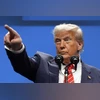 "Donald Trump, Trump")