Monday, January 05, 2026 | 04:31 AM ISTहिंदी में पढें
Business Standard
Notification Icon
userprofile IconSearch

Nato's new higher spending pledge hinges on outcome of Ukraine-Russia war

Though Wednesday's agreement marks a substantial increase over the current goal of 2 per cent the method of measuring this expenditure offers a slightly altered reality
NATO summit, NATO, Donald Trump, Trump
premium

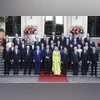
Netherland's King Willem Alexander, Netherland's Queen Maxima and NATO heads of state and government during a group photo at the Paleis Huis ten Bosch on the sidelines of the NATO summit in The Hague, Netherlands, Tuesday, June 24, 2025.(Photo: PTI)

Business Standard Editorial Comment Mumbai

Listen to This Article

American President Donald Trump’s claims of securing a “monumental win” at the annual North Atlantic Treaty Organization (Nato) summit, which concluded at The Hague on June 25, marks a significant shift from his combative stance during his first term. The broad agreement by members to spend 5 per cent of gross domestic product (GDP) annually on defence by 2035 addresses the American President’s contention — insistently raised in his first term (2017-21) — that the United States (US) was doing the heavy lifting in the alliance. This pledge and the overt flattery adroitly heaped on Mr Trump by Nato General Secretary Mark Rutte, who chaired the meeting for the first time, appear to have done the trick. In contrast to his threat to quit Nato during his first term, Mr Trump reaffirmed America’s pledge to uphold Article 5 of the Washington Treaty, the all-important commitment to collective defence. Given that US defence expenditure accounts for approximately two-thirds of defence spending of the alliance as a whole, Mr Trump’s buy-in was critical for the future of Nato in the face of Russia’s expansionary threats in central Europe. 
 
Though Wednesday’s agreement marks a substantial increase over the current goal of 2 per cent, which was approved at the Nato summit in Wales in 2014, the method of measuring this expenditure offers a slightly altered reality. Target spending on “core defence requirements”— that is, troops and weapons that are covered under the old 2 per cent target — has been increased to 3.5 per cent by 2035.  To meet the US President’s demands for a 5 per cent target, Nato has committed itself to spending a further 1.5 per cent of GDP on security-related investment — such as adapting critical infrastructure (roads, bridges, and ports) for military use, cyber security, and protecting energy pipelines. Importantly, the European Union will allow members to raise defence spending by 1.5 per cent of GDP each year for the next four years without invoking the disciplinary steps against deficits crossing 3 per cent of GDP. 
 
Even these differentiated targets, however, would require major spending increases within Nato. Collectively, the alliance spent 2.6 per cent, or about $1.3 trillion, of GDP on troops and weapons but this big number masks considerable spending disparities among individual members. For instance, Poland (4.12 per cent), Estonia (3.43), and Latvia (3.15), countries on the Russian frontline, are among the three largest spenders as a proportion of their GDP. At the bottom of the list comes Spain, Europe’s fifth-largest country by GDP, which spends 1.28 per cent of GDP. These disproportions point to tensions within the alliance. Spain, the sole dissenter, has stated that it can meet its military capability targets by spending less than 3 per cent of GDP. To be sure, Nato still outspends Russia, where military spending rose to $149 million in 2024, 7 per cent of GDP. But critics have suggested that the 2035 target date may be too far out in the horizon to be effective. For one, Ukraine President Volodymyr Zelenskyy, who met Mr Trump on the sidelines and received a reaffirmation of support in the Hague Summit Declaration as a  “partner country”, does not see it as a major deterrent to Vladimir Putin’s imperial irredentism. Indeed, the outcome of the Ukraine-Russia war could be the real test of Nato’s spending commitments.