


From Tokyo to Berlin: Indian states step up global push for investments
Indian chief ministers are increasingly travelling abroad to woo investors, expand markets, and forge global partnerships, marking a new phase of competitive federalism
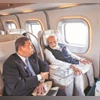 "Prime Minister Narendra Modi and his Japanese counterpart Shigeru Ishiba travelled in the bullet train. | Photo: Reuters")
premium
During his August 29-30 visit to Tokyo, Prime Minister Modi and his Japanese counterpart launched the Indian states–Japanese prefectures partnership initiative. | | Photo: Reuters
5 min read Last Updated : Sep 09 2025 | 7:23 PM IST
Listen to This Article
In his interaction with the governors of 16 of Japan’s prefectures in Tokyo on August 30, Prime Minister Narendra Modi said that his government has “reinvigorated the competitive spirit” among India’s states.
The competitive federalism that the Prime Minister spoke about has been on display over the last year, with an increasing number of chief ministers of states travelling abroad to seek investments.
Such visits have also become salient in the context of the White House imposing steep tariffs on Indian goods and states’ efforts to expand their export markets beyond the United States.
On Monday, Tamil Nadu Chief Minister M K Stalin returned to Chennai from his weeklong visit to the United Kingdom and Germany. He said the state government had signed pacts with 23 companies, including the UK-based Hinduja Group and AstraZeneca, for a total commitment of Rs 15,516 crore, with the potential to create 17,613 jobs.
The Hinduja Group will invest Rs 7,500 crore in Tamil Nadu’s EV ecosystem, focusing on battery storage systems. The initiative would ensure jobs for over 1,000 people. AstraZeneca also announced a strategic investment in Tamil Nadu: a Rs 176 crore expansion of its Global Innovation and Technological Centre in Chennai.
Memoranda of Understanding (MoUs) were also signed with Knorr-Bremse, Nordex Group and ebm-papst during the Tamil Nadu Rising meet in Germany. Ten new companies have come forward for collaborative ventures with Tamil Nadu, while 17 other firms have decided to expand their ventures, Stalin said. “In total, 33 MoUs were signed. My foreign trip has been a huge success,” Stalin told reporters on his arrival in Chennai.
During his August 29-30 visit to Tokyo, Prime Minister Modi and his Japanese counterpart launched the Indian states–Japanese prefectures partnership initiative. As part of this initiative, delegations from at least three Indian states and three prefectures will visit each other’s country every year.
Chief ministers and ministers in state governments and Union Territories are required to seek political clearance from the Ministry of External Affairs for visits abroad. While travelling abroad on official visits, Indian missions and posts assist them in organising events and meetings with key ministers, officials and other stakeholders in that country.
In recent years, most states have organised investors’ summits and their chief ministers and ministers have travelled abroad to seek investments. Some state governments have redrafted and reformed their industrial policies to attract more investments.
Just as the Prime Minister was concluding his Tokyo visit, Chhattisgarh Chief Minister Vishnu Deo Sai was on a tour of Osaka and Tokyo in Japan and Seoul in South Korea from August 24 to 30. After his return, in an interaction with Business Standard, Sai termed his visit a productive one that would help Chhattisgarh secure investments, tap into new export markets for its products, and promote tourism.
“We showcased the state’s new industrial policy and presented our signature products, including Dokra metal craft, Kosa handicrafts, silk products, and the Buddhist heritage of Sirpur. We also organised investor connect sessions in Tokyo and Seoul, where discussions covered sectors such as Artificial Intelligence, semiconductors, clean energy, food processing and skill development,” Sai said.
The Chhattisgarh Chief Minister said six agreements were signed, including one focused on skilling. Japan is keen to conduct skilling courses in Chhattisgarh, and a Japanese delegation is expected to visit the state later this month.
Such visits, as those undertaken by Stalin and Sai, have also become important for state governments when they organise their investment summits in India.
Gujarat Chief Minister Bhupendra Patel told Business Standard in a recent interaction that Japan has confirmed it will be a partner country for the North Gujarat leg of the Vibrant Gujarat Regional Conference, scheduled in Mehsana on October 9 and 10.
“A sister-state agreement between Gujarat and Shizuoka prefecture, and a twinning agreement for friendship and cooperation between Hamamatsu City and Ahmedabad City, have been signed,” Patel said.
“Our focus is on building co-innovation bridges in areas such as mobility and electric vehicles, semiconductors, speciality chemicals, precision machinery, green hydrogen and clean energy solutions. To support this, we are developing industrial infrastructure, particularly in Sanand and Dholera, and facilitation platforms tailored for Japanese companies. Gujarat’s port infrastructure and operational standards are already aligned with Japanese expectations,” he said.
In the case of Andhra Pradesh, whose shrimp exports to the United States have taken a hit because of the 50 per cent tariffs imposed by the Donald Trump administration, making them uncompetitive compared to shrimps from Ecuador, it has become important to look for other markets. The Andhra government is exploring opportunities in West Asia, South Korea, Japan and Europe.
For investments, the Andhra Pradesh government has looked at Singapore, which has been the biggest source of foreign direct investment into India over the last decade. Andhra Chief Minister N Chandrababu Naidu visited Singapore at the end of July.
On September 4, welcoming the visiting Singaporean Prime Minister Lawrence Wong, Prime Minister Modi said India’s states will play an important role in strengthening bonds between the two countries. Over the past year, the chief ministers of Odisha, Telangana, Assam and Andhra Pradesh have visited Singapore, Modi said.
Apart from Singapore, Telangana Chief Minister A Revanth Reddy toured Japan in April, Madhya Pradesh’s Mohan Yadav visited Dubai and Spain in July, and Kerala’s Pinarayi Vijayan has toured more than 25 countries since 2016.
However, there is patchy data on how many of these visits actually lead to increased investments or whether the agreements signed materialise on the ground.
Topics : foreign direct investments Investments Berlin Tokyo