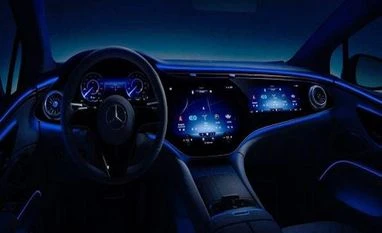
Luxury car market leader Mercedes-Benz India will launch another electric vehicle (EV) model and assemble it locally. This will be one of the 10 models the company plans to introduce in the current year as it seeks to fortify its position in the Indian market, said the company's senior executive.
It will launch the EQC, the five-seater electric sedan in India in the fourth quarter of the current calendar year. It currently sells the EQC coupé here.
“It’s a product that will create significant attraction in the market. We will get a very good response to the model,” said Martin Schwenk, managing director and chief executive officer, Mercedes-Benz India.
It (the local assembly) gives an indication that the company is expecting good volumes, he added.
“There is a good case for the model to be locally assembled. It’s a sedan - a segment we understand really well. We are not talking of some niche segment here,” he said.
Though Schwenk was non-committal on whether the local assembly will enable Mercedes-Benz to price the EQS more competitively than the EQC, which is priced at Rs 1.06 crore (ex-showroom), he said the local assembly will help in “mainstreaming luxury EVs”.
The EQS is the brand’s first all-electric luxury limousine, which, as its nomenclature suggests, is touted to be the ‘S-Class of EVs’.
India levies an import duty of 100 per cent on imported cars if the cost, insurance, and freight (CIF) value exceeds $40,000, or has a petrol or diesel engine with a displacement greater than 3,000cc and 2,500 cc, respectively. For cars that have a CIF value of less than $40,000, the duty is 60 per cent.
Most luxury carmakers have lined up EV models for India. They have been lobbying with the Indian government to reduce the goods and services tax on imported EV models. Schwenk said there has been no progress on that front yet.
Retaining its leadership position in the segment for the seventh straight year, Mercedes-Benz sold 11,242 units in 2021 - up 42 per cent year-on-year (YoY). Most of the other luxury carmakers also saw the 2021 sales advance at a brisk pace YoY.
While sales at BMW India soared 34 per cent to 8,876 units, Audi reported sales of 32,921 units — up 101 per cent YoY. The sales came on the back of a low base of 2020.
Commenting on the overall impact of the third wave on the luxury car segment, Schwenk said the showroom walk-ins have not been impacted substantially. He expects a sharp bounce-back in much the same way after the second wave of Covid-19.
The global shortage of semiconductors, which have been crimping global production, is unlikely to ease for another six months or so. “We will have a year of shortage in supplies,” he said, adding that the immediate threat is from a business shutdown. As far as possible, lockdowns must be avoided, he pointed out.
As part of its “product offensive” for Indian customers in 2022, Mercedes-Benz plans to launch the new S-Class Maybach and the EQS, along with many other offerings from the AMG stable, in the current year. A strong demand pull for its models will help the German automotive major achieve double-digit growth even in the current year, said Schwenk.
At the end of 2021, Mercedes-Benz had an order book of over 3,000 models, with a waitlist for some models being as high as six months. The GLA, GLC, GLE, GLS, A-Class, E-Class, and the S-Class are the models on the waitlist.