A start-up survival guide

Book review of The Fail-Safe Start Up
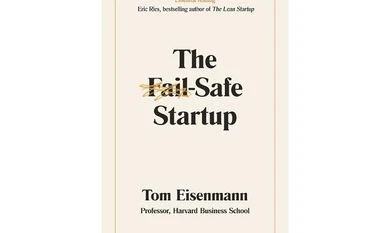
Book cover
Book cover of The Fail-Safe Start Up
Srivatsa Krishna
5 min read Last Updated : Mar 31 2021 | 11:13 PM IST
It is rare for a Harvard Don to start a book by saying “I don’t know”. That’s exactly what Tom Eisenmann does when he drills into the reasons start-ups fail. Many studies and tomes exist on successes but hardly any on failures. 

Dr Eisenmann’s book fills this gap brilliantly. There is hardly any agreement in both academia and the real world on both — what constitutes entrepreneurship much less as to how to define failure. He defines failure as “early investors did not and never will make money” and creates compelling frameworks to show failure in all stages of a start-up’s life cycle.

One of the main characteristics of the “big software” companies was that they produce boxes claiming their box to be better than their competitors’ box in solving some problems. Namely, they were a solution in search of a problem whereas startups do exactly the opposite. They look at problems and try to find a solution which would relieve a pain point and then hope to scale in order to get to the market and, of course, make millions. Dr Eisenmann’s book is a classic, easy-to-read bible on what not to when doing start-ups from this point of view also.

The book has innumerable interesting cases. Take the case of Jibo, which, in 2013/14, became the first-of-its-kind social robot meant to give companionship to seniors as well as be around the home. Jibo raised $73 million but did not takeoff and to date the jury is out on whether you consider it a failure or success.  Perhaps it was just a product to be ahead of its time, for now you have robots made by Boston Dynamics and other companies that are extremely close to mimicking human behaviour and can do mundane repeatable tasks far quicker, much more error-free than humans ever again. In China during Covid times there were numerous examples of social robots getting medicines and giving companionship to those seriously infected in the containment zones, who had lost all hope. Would Jibo have been a huge success had it  been launched in the year of the pandemic?

The Fail-Safe Start Up
Author:Tom Eisenmann
Publisher:  Penguin
Pages: 345 Price: Rs 599

Likewise, Better Place, an extremely promising start-up with Israeli brain power behind it, raised $900 million to set up a network of charging stations for electric vehicles. It is a fascinating journey of a brilliant idea, from the US to Israel to Denmark, from charging stations to batteries to electric vehicles, and leads us to Dr Eisenmann’s brilliant exposition of “cascading miracles”.  Was Better Place simply a bad idea fated to fail, right from the start? Not necessarily, but it was a moonshot: A venture so ambitious that Better Place would have had to meet a number of requirements, or it would come crashing down. And with so many challenges, it would be remarkable if each and every one of them worked out.

Better Place fell victim to a late-stage failure pattern— the cascading miracles of Dr Eisenmann’s theory. With this pattern, a start-up pursuing bold innovation faces many big challenges, but a shortfall with any one of them will be sufficient to kill the venture. Consequently, the start-up needs a cascade of miracles to succeed. Even if one thing in a chain goes wrong — which is likely in almost any venture — then the whole start-up fails. But Tesla and SpaceX have lots of cascading miracles working for them!

Eric Ries in his classic  The Lean Startup  defines a start-up’s runway not in the conventional way—as the number of months remaining before the start-up exhausts all of its capital at its current cash “burn rate”— but rather as the number of pivots the start-up can complete before its cash reserves are depleted. Sunil Nagaraj, a Harvard Business School fellow alum, discovered this to his disappointment when he founded Triangulate. His premise was that “triangulating” a profile from computer-generated behavioural data would paint a more accurate picture and thus result in better matches than the self-reported information used by many matching sites. He fell a prey to what Dr Eisenmann calls “false starts” by ignoring the customer value proposition, marketing and profit formula. Early-stage failure is broadly categorised in two diametrically opposite corners. One, which has strong founders, great teams, good resources but couldn’t find the right opportunity and the other, which found a great opportunity but weren’t able to mobilise the resources to capture it.

The only gripe with the book is that it is predominantly US-centric, even though the start-up universe is no longer unipolar. It is to be hoped that Dr Eisenmann spends more of his time and research on Asia  to help start-ups here prosper. Start-up founders in India and elsewhere will find remarkable nuggets to learn from Dr Eisenmann’s  brilliant scholarship. He is a rare academic who worked as a Partner at McKinsey before turning to academia — and this varied experience imbues his insights with both practical richness and academic rigour.

The reviewer is an IAS officer. Views are personal. @srivatsakrishna

One subscription. Two world-class reads.

Already subscribed? Log in

Subscribe to read the full story →
*Subscribe to Business Standard digital and get complimentary access to The New York Times

Smart Quarterly

₹900

3 Months

₹300/Month

SAVE 25%

Smart Essential

₹2,700

1 Year

₹225/Month

SAVE 46%
*Complimentary New York Times access for the 2nd year will be given after 12 months

Super Saver

₹3,900

2 Years

₹162/Month

Subscribe

Renews automatically, cancel anytime

Here’s what’s included in our digital subscription plans

Exclusive premium stories online

  • Over 30 premium stories daily, handpicked by our editors

Complimentary Access to The New York Times

  • News, Games, Cooking, Audio, Wirecutter & The Athletic

Business Standard Epaper

  • Digital replica of our daily newspaper — with options to read, save, and share

Curated Newsletters

  • Insights on markets, finance, politics, tech, and more delivered to your inbox

Market Analysis & Investment Insights

  • In-depth market analysis & insights with access to The Smart Investor

Archives

  • Repository of articles and publications dating back to 1997

Ad-free Reading

  • Uninterrupted reading experience with no advertisements

Seamless Access Across All Devices

  • Access Business Standard across devices — mobile, tablet, or PC, via web or app

Topics :Start-upsBOOK REVIEW

Next Story



