At a time of conflict, Sopore's Zahida Amin turned her focus to woman power

For four years, Amin successfully ran her typing school, training up to 200 students at a time
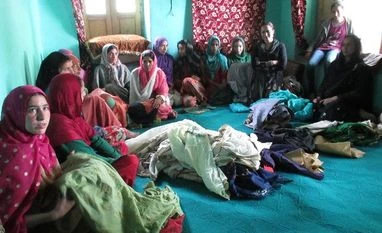
Identifying talented women who embroidered on cloth, Amin  started Naie Kiran when militancy was at its peak in the Valley
Identifying talented women who embroidered on cloth, Amin started Naie Kiran when militancy was at its peak in the Valley
Anjuli Bhargava
Last Updated : Jul 29 2017 | 8:35 PM IST
The year was 1993. Jammu and Kashmir’s Baramulla district was the hub of militant activity. Rarely did a day go by without a confrontation between the militants and the army. Gunfire, explosions and death had become a common occurrence — a way of life. Few would have forgotten the Sopore massacre of January 6, 1993 in which 55 Kashmiri civilians were killed.

Job and earning opportunities for both men and women were — and remain so — few and far between. Joblessness reigned. Many innocent people found themselves caught between the army on the one side and the militants on the other.

Right in the middle of this turbulent time, Zahida Amin, a young woman from Sopore, got together with two friends and started a centre for embroidery. The centre, which employed women from the nearby towns of Pattan and Warpura, came up when militancy was at its peak; few men were able to make ends meet or find any source of income — let alone the women.

But this is getting a bit ahead in the story. Daughter of a fairly well to do transporter in the area, Amin had never believed in following expected social norms. While her younger sister was married while still in school, Amin finished her schooling in the science stream. 

She went on to earn a bachelor of arts degree from the Women’s College in Sopore and on the side finished a course in shorthand and typing. She later worked for a year as a tutor at the very school where she learnt typing, but soon started a typing and shorthand school of her own in 1993-94 — competing with her former employers. This was unusual since very few men in the region at the time showed as much enterprise as Amin. 

For almost four years, Amin successfully ran her typing school, training up to 200 students at a time. As a result, she was financially independent.

At the time, both Sopore and Pattan were disturbed areas and many NGOs were working here to help those affected by militancy, especially those who had lost a family member in the violence. Amin, too, started chipping in with one of her relatives who worked with an NGO as a volunteer. Soon, she found herself also working with children who were victims of violence.

Around this time, she came across Renuka Misra and Primila Lewis of Sadbhavana Trust who offered to start a programme to help women in the area find ways of earning a living. 

It was then that Amin and a couple of her friends identified a niche: a lot of women in the area embroidered on cloth and produced impressive work. So, a training centre called Naie Kiran was started and 12 to 15 women began coming to it daily. Funds were organised to purchase some shawls and the women started doing embroidery on these. 

Not long after that, Laila Tyabji who runs Dastkar, the Delhi-based NGO that works for the revival of traditional crafts in India, visited the training centre. She invited its women to come with their work to Delhi that November of 2004 to participate in the Dastkar Bazaar, the annual winter fair that was then held at Dilli Haat, the open-air food plaza and craft bazaar in South Delhi. For the fair, 300 to 400 pieces of clothing (mostly shawls and stoles) were provided for embroidering on — with the support of Dastkar and Sadbhavana Trust. (A Confederation of Indian Industry grant helped support the project initially.)

Amin and her friends gathered as many women as they could to ensure that they finished the work for the November mela. “The women were extremely happy to be able to earn even a small amount,” she recalls. Any extra income was welcome. 

Sales at the fair amounted to Rs2.75 lakh. And although they did not sell the entire lot they had brought with them, it was a shot in the arm. The small group from Kashmir went back happy and content. Payment to the women who did the work was made on a per piece basis. 

In 2005, the group took part in a Dastkar fair organised in Bengaluru.
 
Identifying talented women who embroidered on cloth, Amin started Naie Kiran when militancy was at its peak in the Valley

Although Amin had visited Delhi earlier, most of the women had come to the national capital for the first time — braving a lot of opposition and barbs from people back home who were opposed to the idea of giving so much freedom to the girls. 

Amin recalls how one of the girls had to jump out of the window of her room to join the group on the train to Delhi. Her brother had locked her in to prevent her from going. 

There were three young women who came together as Naie Kiran to work with the village women,” recalls Tyabji who has watched the birth and growth of the group closely. “Two left the project when funds dried up. Zahida turned out to be the one with the staying power, guts and determination.”

Amin says Tyabji’s support has been “invaluable”. With her deep understanding of the urban clientele and their tastes, Tyabji helped in terms of colours, aesthetics and designs. 

It has been delightful to witness the change in Amin and the other women involved in the project, says Tyabji. “As important as the earning and empowerment, Amin and her group of village women have gained a better understanding of India. Interacting with other artisans at our bazaars and hearing their stories, they can see that poverty, hardship and discrimination are not confined to Kashmir.”

Naie Kiran, which started with a dozen women, now supports anywhere between 45 and 50 women from the Valley at any given time. Whenever they have more work, more girls are pulled in on a temporary basis. 

Besides Dastkar, they have participated in several other fairs and have diversified their range of products. 

The women earn anywhere between Rs3,000 and 9,000 a month, depending on how much work they take on. The small operation is profitable and Amin does not need any financial support from her parents. She has chosen to stay single. Now 45, she says she likes the feeling of not being dependent on anyone. It’s a rare privilege for a girl from her background, upbringing and circumstances.

One subscription. Two world-class reads.

Already subscribed? Log in

Subscribe to read the full story →
*Subscribe to Business Standard digital and get complimentary access to The New York Times

Smart Quarterly

₹900

3 Months

₹300/Month

SAVE 25%

Smart Essential

₹2,700

1 Year

₹225/Month

SAVE 46%
*Complimentary New York Times access for the 2nd year will be given after 12 months

Super Saver

₹3,900

2 Years

₹162/Month

Subscribe

Renews automatically, cancel anytime

Here’s what’s included in our digital subscription plans

Exclusive premium stories online

  • Over 30 premium stories daily, handpicked by our editors

Complimentary Access to The New York Times

  • News, Games, Cooking, Audio, Wirecutter & The Athletic

Business Standard Epaper

  • Digital replica of our daily newspaper — with options to read, save, and share

Curated Newsletters

  • Insights on markets, finance, politics, tech, and more delivered to your inbox

Market Analysis & Investment Insights

  • In-depth market analysis & insights with access to The Smart Investor

Archives

  • Repository of articles and publications dating back to 1997

Ad-free Reading

  • Uninterrupted reading experience with no advertisements

Seamless Access Across All Devices

  • Access Business Standard across devices — mobile, tablet, or PC, via web or app

Next Story


