Sports fans like GOAT (greatest of all time) arguments. Chessplayers have relatively long careers which allows direct comparisons unlike other sports. Mikhail Botvinnik (born 1911) who won the title in 1948, played Emmanuel Lasker, champion in 1896, when the 60-plus Lasker was still in the top ten. Games of prior eras are also preserved. Statistical gurus have tried normalising ratings across eras. Elo invented his system for that purpose.
Another approach is to dissect games using engines and databases to enumerate errors. The problem here is, the opening and endgame theory developed through practice. An old timer who played what is now known to be a howler cannot really be castigated. There is also "complexity". Players who specialise in complex imbalanced positions make more errors than those who keep things simple.
Chessbase reports on an interesting experiment. Matej Guid and Ivan Bratko, computer scientists from the University of Ljubljana, Slovenia, have a system of assessment they've written several papers about.
They analyse using engines from move 12 on (earlier errors are "forgiven"). They compare moves played with engine assessment of best moves (using set search depths). Big blunders are cut off at a maximum evaluation of 3.00 to prevent a single gross error overly influencing scores.
When the move played and the comp suggestions are both outside an interval of -2 to +2, there is no penalty. This is because, in winning positions (+2 is winning), a human player may choose a practical move where a computer seeks the best. After these adjustments, the evaluation differences between best move and human moves are averaged. It's an ambitious method of assessment though, of course, conclusions will be debated hotly.
According to this, Magnus arlsen and Vladimir Kramnik were fantastically accurate at the Candidates. One odd counter-factual - the Guid-Bratko method gives Ivan Grischuk a very good accuracy score though Grischuk had a poor result.
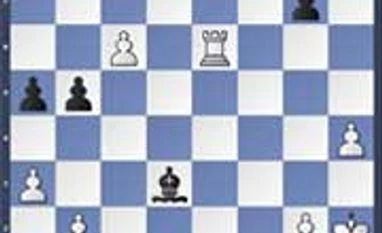
The diagram shows how even the best make errors. WHITE TO PLAY, (
Aronian Vs Kramnik, Candidates London 2013). Levon Aronian finds a great idea with
32.Re3! Bb1 33.Rc3! Rxc3 34.bxc3 Kg8 35.c7 Bf5 36.Kg3 Kf7 37.Kf4 Bc8 38.Kg5 Bd7 39.h5 Be6 40.g3 a4 41.g4 Kf8 42.Kf4 Ke7 43.g5 Kd7 44.Ke5 Bg8 45.c8Q+ Kxc8 46.Kd6 Kd8 47.Kc6 Ke7 48.Kxb5 Ke6 49.Kxa4 Kf5.
So far so good. The "obvious" draw is 50.h6! g6 51.Kb5 Kxg5 52.a4 Kxh6 53.a5 g5 (53...Kg7? 54.c4 wins for white.) 54.a6 g4 55.c4 g3 56.a7 g2 57.a8Q g1Q 58.Qf8. Instead
50.g6?? Kg5 51.Kb5 Kxh5 52.a4 Kxg6 53.a5 Kf6 54.a6 Bd5 55.c4 Ba8 56.Kb6 Ke5! Not 56...g5 57.c5 g4?? 58.c6 Ke7 59.c7 Kd7 60.Ka7 Kxc7 61.Kxa8 g3 62.a7 g2 stalemate.
57.Kc7 g5 58.Kb8 Be4 59.Kc7 g4 60.a7 g3 61.c5 Ba8 62.Kb8 Bc6 (0-1) . It could end 63.a8Q Bxa8 64.Kxa8 Kd5 65.Kb7 Kxc5.
Devangshu Datta is an internationally rated chess and correspondence chess player

 "Chess (#1038)")


 Connect with us on WhatsApp