How does China’s rise affect the Sino-Indian border contest, the chances of Sino-Indian cooperation in Asia, and India’s relationships with America and Russia?
In his book, Powershift, Zorawar Daulet Singh raises questions about Sino-Indian ties and appears optimistic that China-India cooperation can reshape the world order, even as the border dispute creates doubts about their ability to find their way and work together in a changing world. With the Sino-Indian border conflict remaining unsettled, can India and China maintain their balancing act, especially after last June’s border clashes in Ladakh?
China is already challenging the US. India’s choices will shape its economy and the regional world order. Dr Singh could have added that with India four decades behind China economically the chances of its turning the balance of power in Asia, even in South Asia, are limited.
He assumes that the US is a declining superpower. A comparison of US-China defence spending alone shows that America’s is $732 billion, China’s $251 billion. India’s is $71 billion. Donald Trump did not use that power militarily or in multilateral institutions. Instead he declared a trade war on China and on many of America’s friends. The US is unwilling to accept Chinese expansion in Asia and globally. Additionally, Dr Singh is unclear what he means by saying that India can pay a role in a “post-hegemonic world order”.
India’s diplomacy reflects the multiple strands comprising its national interest. With Russia, India wants to legitimise multi-polarity. With America, it favours a free and open maritime commons.
Pages: 335; Price: Rs 650
India has always wanted to improve its access to the forward areas. But China has several advantages, including flatter turf on its side of the border, superior technology and infrastructure. So its army does not need to maintain a permanent presence on its side of the LAC. India stands on harsher terrain, which entails more troop deployments near or at the LAC. The Indian and Chinese strategies to manage the border dispute, therefore, differ.
China does not wish to define the LAC because it is unsure what geopolitical benefits this would present. Narendra Modi’s China policy has been tough on everything from the Belt and Road Initiative to stronger defence ties with the US and 5G technology. But is Dr Singh too optimistic that India can woo Russia to promote a balance of power in Eurasia? More evidence on the military and economic aspects of Sino-Russian comprehensive strategic partnership may have revealed whether or why China is more important to Russia than India.
Has India succeeded in creating the equilibrium it wanted with China? A complex picture emerges. Dr Singh is against “unrestrained” competition because it will limit the room for manoeuvre of other powers. Equilibrium is essential to avoid unrestrained, destructive competition and to facilitate India’s rise to great power.
At another level, the economic and military gap is in China’s favour. Here the reader could ask what India’s chances of becoming a great power in the foreseeable future are, given its economic decline over the last few years — which has only widened its gap with China. Chinese sources often point to India’s poor economic performance, while showing awareness that their country’s global prestige rests on its far stronger economic base.
Dr Singh holds that India and China should craft a concept of regional welfare and human security. Realism demands greater economic interdependence with Asian countries, but India’s absence from any regional economic deal will only make it more difficult to forge interdependence.
Dr Singh could have made more of the fact that China’s interdependence with other Asian countries is far stronger than India’s and estimated the role India might play in being a partner of an Asia which he foresees as flourishing economically. India and China could coordinate policies to help weak Asian countries. In the face of China’s wolf warrior stance, does Dr Singh remain too optimistic about the ability of India and China to maintain their balancing act in a fast-changing multipolar world, in which China has displayed its expansionism?
Somewhat theoretical in places, the book is heavy reading at times. But it raises the useful question of why China’s assertion of sovereignty over Galwan suggests more Sino-Indian political and economic competition. India’s growing ties with the US do not point to a brighter future for Sino-Indian ties. The author seems optimistic about India emerging as the counterpoise to China’s growing power in Asia. Yet aren’t the chances that America, not India, will remain the main balancer to China in Asia?
The reviewer is a founding professor of the Centre for Peace and Conflict Resolution in New Delhi. www.anitaindersingh.com

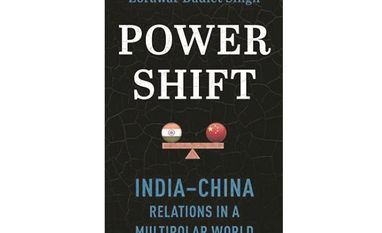 "Dimensions of a Sino-Indian future")












 Connect with us on WhatsApp