Myths about gender

Mythology and folklore certainly examined the issues around gender with a boldness that seems way ahead of its times
mahabharata, history, folklore
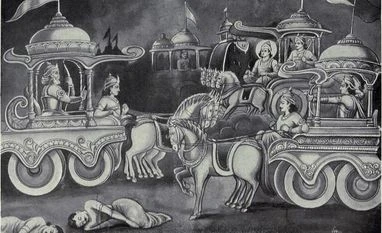
GENDER BENDER: In the Mahabharata, Bhishma (left) refused to fight Shikhandi
Arundhuti Dasgupta
Last Updated : Sep 14 2018 | 9:39 PM IST
Last week, the five-judge Supreme Court bench unanimously overturned Section 377 of the Indian Penal Code to decriminalise sexual relations between consenting adults of the same sex. The spectacular 495-page verdict drew from a wide range of philosophical and literary texts to explain its decision and to interpret the issue of gender beyond the male-female binary. 

Identity and sexual preference are a function of dignity and liberty, the judgement implied. One has the right to choose and it is only when the individual’s choice is respected that we can emerge as a truly equal nation. This may seem like a remarkably bold assertion in today’s context, but it is quite an ancient premise.

In the Mahabharata, Bhishma tells Yudhisthira a story about a king who transformed into a woman and chose to remain one when he had the choice to return to his old form. King Bhangaswana knew life as both man and woman but preferred to retain his female identity because, he said, “In acts of congress, the pleasure that women enjoy is always much greater than what is enjoyed by men....” 

Bhangaswana was tricked into becoming a woman when he incurred the wrath of the king of gods, Indra. For a bit of backstory, the king was childless and had sought out Indra’s rival Agni for respite, and was subsequently blessed with a hundred sons. But Indra was seething and one day, he lured Bhangaswana during a hunting expedition into the deceptively calm waters of a magical lake. The king stepped out of the waters as a woman and, after dramatic encounters with former wives, children and courtiers, exiled herself. She found shelter in an ashram where she began life anew, with an ascetic as partner, and bore him another 100 sons. But Indra continued to inflict pain on the former king until she finally invoked his name in her prayers. Happy to have a new devotee, Indra offered to restore her identity as a male. Much to Indra’s surprise, she refused. 

A similar story is commonly told in Gujarat about Bahuchara Mata, a goddess worshipped by eunuchs. Bahuchara was married to a prince who refused to spend a night with her. Instead, he would mount his horse and trot off into the jungle every night. One night, Bahuchara followed her husband only to discover that the prince would don women’s clothes and spend the night frolicking in the forest. When confronted, the prince begged her forgiveness. He was not interested in women, he said, but his parents had forced him into marriage to father children. Bahuchara forgave him but on condition that he and those like him would worship her as their goddess.

GENDER BENDER: In the Mahabharata, Bhishma (left) refused to fight Shikhandi
Mythology and folklore certainly examined the issues around gender with a boldness that seems way ahead of its times. But to read the old tales to seek sanction or validation of sexual behaviour, as many have done to justify their opposition to the recent judgement, is futile. 

In the epics, too, gender plays an important role. In the Mahabharata, when Arjuna opts to spend his year in exile as a transgender, he is signalling the diversity of human identity. Similarly, Amba reborn as Shikhandi indicates acceptance of the third gender even among the elite of the time. And when Bhishma refuses to fight Shikhandi, he stands up for the then prevalent male-centric moral code of behaviour. 

The gods, too, were open about their gender-bending behaviour. Krishna is believed to have often paraded himself in women’s clothes. Also he turned into a woman for a night to fulfil the last wish of Aravan, son of Arjuna and the Naga princess Ulupi. Aravan was to be sacrificed for the greater good of the Pandavas and he agreed, but lamented that he would never know marital bliss. So Krishna became his wife for a night. Krishna’s son, Samba, is an incarnate of Shiva in his ardhanareeshwara (man-woman) form, and although the stories hold him responsible for the destruction of the Yadava race, Krishna never rejected him. As the Supreme Court judgement says, “We must realise that different hues and colours together make the painting of humanity beautiful and this beauty is the essence of humanity.”

One subscription. Two world-class reads.

Already subscribed? Log in

Subscribe to read the full story →
*Subscribe to Business Standard digital and get complimentary access to The New York Times

Smart Quarterly

₹900

3 Months

₹300/Month

SAVE 25%

Smart Essential

₹2,700

1 Year

₹225/Month

SAVE 46%
*Complimentary New York Times access for the 2nd year will be given after 12 months

Super Saver

₹3,900

2 Years

₹162/Month

Subscribe

Renews automatically, cancel anytime

Here’s what’s included in our digital subscription plans

Exclusive premium stories online

  • Over 30 premium stories daily, handpicked by our editors

Complimentary Access to The New York Times

  • News, Games, Cooking, Audio, Wirecutter & The Athletic

Business Standard Epaper

  • Digital replica of our daily newspaper — with options to read, save, and share

Curated Newsletters

  • Insights on markets, finance, politics, tech, and more delivered to your inbox

Market Analysis & Investment Insights

  • In-depth market analysis & insights with access to The Smart Investor

Archives

  • Repository of articles and publications dating back to 1997

Ad-free Reading

  • Uninterrupted reading experience with no advertisements

Seamless Access Across All Devices

  • Access Business Standard across devices — mobile, tablet, or PC, via web or app

Next Story



