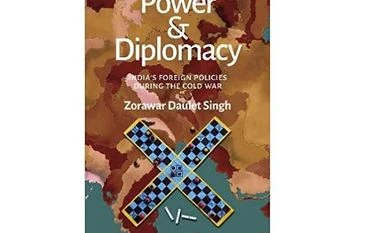
Nonalignment was practised in different ways by Jawharlal Nehru and Indira Gandhi. Zorawar Daulet Singh’s historical account of the changes in India’s foreign policy made largely by the two prime ministers is based mainly on available official archives in India, Britain and the US. The private records of aides, including P N Haksar, T N Kaul and D P Dhar, illuminate the crafting of India’s foreign policy. Of interest to specialists in Indian foreign policy, it covers the period from independence to 1975. This time-frame should have been mentioned in the title of the book. The Cold War, after all, lasted until the collapse of the Soviet Union in 1991.
The author throws light on the ways in which the competing ideas of Indian officials, their reactions to regional and world events — and the personalities of both prime ministers — shaped India’s diplomacy. The crises during which Indian foreign policy evolved included some of the same strategic theatres: East Bengal (1950s, 1971), Formosa and Indochina (mid-1950s and mid-1960s). Additionally, the book analyses the handling of Goa (1961) and Sikkm (1970-5) by Nehru and Indira Gandhi, respectively.
Nehru was as aware of the power of realpolitik and the significance of the balance of power as Indira Gandhi. He nonetheless believed in India’s indivisible security with its neighbours and its ability to contribute to Asian and world peace. By the time Indira Gandhi became premier in 1966, India had been defeated by China and there was no sign of an end to the border conflict with Pakistan. Sceptical about winning over neighbours through concessions, she used war as an instrument to end the humanitarian crisis created by Islamabad’s genocide in the former East Pakistan, to break up Pakistan and to create the new state of Bangladesh.
Nonalignment developed during the early Cold war. Mr Daulet Singh goes along with critics of the pro-western tilt of Nehru’s foreign policy. But what did the Soviets then offer India? Until Stalin’s death in 1953, they condemned Nehru as a camp-follower of imperialism. Even when ties improved under Nikita Khrushchev, the USSR was unable to compete with the West as an aid-donor. The book itself shows that Indira Gandhi refrained from lecturing Washington on Vietnam because only the US could give India the food it needed.
Moreover, if Nehru was really inclined towards the West, why did Britain and the US perceive nonaligned India as being “pink”, if not “red”? Did part of the answer lie with Nehru’s close confidant, Krishna Menon? In 1948 the US envoy, Loy Henderson, who couldn’t stand nonalignment, recorded Krishna Menon’s acidulous greeting: “Well, this is interesting; you are the first American Ambassador who has ever darkened my threshold.” Another US official reviled him as “a poisonous fellow”, actively inimical to Americans.
The author could have added “inter-national” depth to his account by revealing how British and American reports of meetings with Indian diplomats corroborated or differed from Indian accounts. Western officials always made some personal comments about their Indian counterparts. How did Indian diplomats relate personally to the British and American officials with whom they negotiated? And did personal impressions shape their images of the West and of India’s world role?
At another level, what did India make of the fact that 13 out of the 28 countries attending the Bandung Conference in 1955 were Western allies? Was India aware that Britain and the US persuaded several Asian countries to criticise Nehru’s anti-colonialism? Or that the charm and peace-talk of Zhou Enlai, invited at India’s initiative, impressed even the arch-cold-warrior John Foster Dulles, who “saluted” his performance at Bandung (although he doubted Chou’s sincerity)?
Mr Daulet Singh is rightly aware of the link between India’s early and contemporary foreign policies. Could he have said more about the connection between domestic and foreign policy? After all, the methods of handling foreign and domestic affairs can be analogous. Although India was one of the world’s poorest countries when it became independent, Asia’s economic tigers had yet to spring up. Nehru’s India was widely respected because of his intellectual, political and moral calibre, and — as British and US records make clear — his forging of the Indian state-nation through democratic consensus.
The accountable, internationally esteemed domestic consensus builder was the natural bridge builder in world affairs in ways that neither Indira Gandhi, nor any other Indian practitioner of realpolitik, could ever be. Nehru’s consensus and bridge-building stand out when one realises that, further afield, towards the West, no post-communist European country has achieved a strong political consensus – despite receiving EU largesse and “democracy assistance”.
The ways in which India secures its interests in a dynamic world will, of necessity, change. Nehru did not want India to be mean, especially to its smaller neighbours. His principled pragmatism contrasts with the current petty “transactionalism” in foreign policy. That has led many of India’s smaller neighbours — and Asian countries — to turn to its greatest rival, China, despite the boasts about India’s global power. Perhaps Mr Daulet Singh could write more about the link between domestic and foreign policy in his next well-researched book?
Power & Diplomacy: India's foreign policies during the Cold War
Zorawar Daulet Singh
Oxford University Press
398 pages. Price: Rs 845
The writer is a founding professor of the Centre for Peace and Conflict Resolution in New Delhi. Website: www.anitaindersingh.com
Read this article for free
Register to continue reading premium journalism and analysis from Business Standard.

 "The two faces of nonalignment")












 Connect with us on WhatsApp