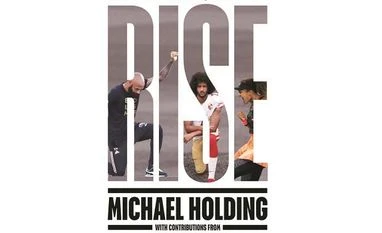
Successful sportspeople usually venture into the literary world to write memoirs. Michael Holding, the West Indian fast bowler who played for the famous team that dominated world cricket for 15 years in the eighties and nineties, has been there and done that. This book is not a celebratory chronicle; it takes a hard look at racism, why it endures and what we can do about it.
In retirement, Mr Holding, a personal favourite among those ruthless West Indian quicks of that era for his fluent action, became a talented and phlegmatic commentator. So when a clip showed the big man, known as “Whispering Death” for his silent run-up, tearing up during a discussion on racism it went viral and played its part in producing this book.
The clip was broadcast live during a rain break in a Windies-England match at Southampton. With no cricket to talk about, there was only one topic burning up the world headlines — the murder of George Floyd by police in Minneapolis in May 2020 and the Black Lives Matter protest movement that had erupted across the US.
When Mr Holding was asked to comment, the dignified eloquence wobbled when he spoke of the ingrained racism among Black people, too, and how he discovered that his mother’s family ostracised her for marrying his father who was “too dark”.
This book, named for the American footballer Colin Kaepernick’s famous protest against institutionalised racism in the US, suggested itself after Mr Holding received an avalanche of responses to the clip and partly atones, he admits, for not speaking up before. Born in post-independence Jamaica, he was dimly aware of racism growing up. Like many Black people at the time, he chose to ignore slurs when he encountered them overseas on the assumption that he’d be home soon anyway.
But the resentment lingers not least because of the way the White cricketing establishment treated Clive Lloyd’s marauding team. “A bunch of Black guys coming together and dominating was unprecedented. And the old colonial powers didn’t like it…. We were terrorists. We were bringing the game into disrepute...,” he writes. This although Clive Lloyd had gotten the idea of an intimidating pace attack from the Aussie duo of Dennis Lillie and Jeff Thomson.
That experience dictated why Mr Holding chose to present this exposition through the prism of celebrity Black sportspeople — Usain Bolt, Naomi Osaka, Hope Powell, Ibtihaj Mohammad, Michael Johnson, Thierry Henry, Makhaya Ntini, Adam Goodes. He doesn’t just relate their stories but uses them as the foundation to discuss aspects of racism. Remarkably that all of them, whom the multitudes — black, white and every shade in between — adored at the height of their triumphs, suffered overt and covert racism.
All of them recall being specifically instructed by their parents on how to behave when the cops stop them.
Though the book has been written in a remarkably short time, it is by no means a “hashtag” critique. It speaks directly to ordinary readers without filters. “I want to show how the dehumanisation of a race of people began and was then encouraged to satisfy the narrative of inferiority and superiority,” Mr Holding writes in the introduction.
WHY WE KNEEL, HOW WE RISE
Author: Michael Holding
Publisher: Simon & Schuster
Pages: 306; Price: Rs 699
This is a difficult conversation but Mr Holding eschews self-pity and sermonising for hard fact. Some of the discourse is familiar — slavery, the asymmetric treatment of Black people by White institutions. But it still has the power to shock when you learn that in the sixties and seventies, for example, Black kids were herded into “MSN” schools in the UK, the initials spelling Mentally Sub Normal. The chapter on why White people are afraid of Black people is particularly powerful.
He presents aspects of Black history that are whitewashed: That Africans “discovered” America centuries before Columbus turned up, and they left a far more constructive legacy; that the Square Mile in the City of London was defined by a Black Roman emperor Septimius Severus; how the technique of vaccination was developed in Africa and first propagated by a slave in America, Onesimus, before Edward Jenner co-opted it; how the actual light bulb was created by an African American, Howard Latimer, but Thomas Edison gets the credit; how Mathew Hanson, a former slave and Robert Peary’s team-mate, was really the first man to reach the North Pole. Read also about the Harlem Hellfires, the first Black regiment to fight on the Western Front in World War I. It fought alongside the French because American GIs refused to do so. Worse, the US refused to allow the French to put up a memorial to their gallantry.
Some of these distortions are being corrected now, and there are signs of recognition that racism is a social evil. It’s encouraging when some European teams choose to take a knee before each match in Euro 2021. When fans boo and send hate mail, you wonder whether the message is getting through.
For Mr Holding, kneeling — often condemned as “virtue signalling” — is the starting point for Black people to rise. His answer is to reorient education so that all children learn that Blacks are descendants of a proud civilisation on the shoulders of which Europe stood. That’ll take some doing when politicians such as Boris Johnson talk of “editing history”. Mr Holding’s response: History “has already been edited to suit a particular narrative. We need the unedited version.”