Winning the turf war
The Indian hockey team's stunning Test series win over world champions Australia has sparked hopes of a revival. The Champions Trophy in December will be the real test
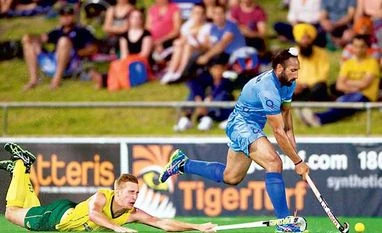
Aabhas Sharma This past week, the Indian hockey team recorded a rare Test series win against world champions Australia. It was a significant achievement by the men in blue - hockey, not cricket - as it was for the first time in four years that India had beaten Australia.
In fact, the Indian hockey team is somewhat on a roll. India won the Asian Games gold and beat Asian powerhouses South Korea and Pakistan, and in the process also qualified for the 2016 Rio de Janeiro Olympics. The team also won the silver at the 2014 Glasgow Commonwealth Games. Is Indian hockey on the road to revival? Or is it another false dawn?
"I won't call it a revival of any sort but it's heartening to see the team doing well. Beating Australia will do wonders to the confidence," says former India captain Pargat Singh. Singh says that the best thing is that it actually looks like a team and not a collection of individuals playing together. "This shows that if you stick with a core group of players, results will certainly follow," adds the two-time Olympian.
Cynics might point that it was a "second-string" Australian team: it didn't have captain and fullback Mark Knowles, iconic superstar Jamie Dwyer and a couple of other regulars. "They still were a very good side," says former India midfielder Viren Rasquinha. "The absence of two or three players doesn't make much difference to them," he adds.
One of the most notable differences with this team is that it doesn't give up and does not have a defeatist mentality that plagued the hockey teams of the past. They won the silver at the Commonwealth Games in Glasgow after losing 0-4 to Australia in the group stages. They went down to Australia by the same margin in the first test of the recently concluded series, yet bounced back to win the next three.
Maharaj Krishan Kaushik, manager of the team that won the gold in Incheon and now a performance director with Hockey India, says that the series win is a sign of the progress the team is making. "We are delighted with the victory and it shows that the team is on the right path," he says.
There is an abundance of talent in the team now. P R Sreejesh, the goalkeeper and hero of the Asian Games, is considered a top talent. Captain Sardar Singh, who recently won his 200th cap for India, is the heartbeat of the team. Defender V Raghunath is an experienced head now, and along with Rupinder Singh and Gurbaj Singh, provides India with defensive solidity at the back. "They've been playing together and there is a better understanding in the team," says Kaushik.
The change in the format too seems to have benefited the Indian team. Now, a hockey match is divided into four quarters of 15 minutes each. In the new format, teams have a two-minute break at the end of the first and third quarter. The 10-minute break during half time is still there. And every time a penalty corner is awarded or a goal is scored, there is a 40-second time-out. "I am not sure how much of it is down to the new format," says Pargat Singh. Though most Indian players have had the experience of the new format during the Hockey India League, internationally the format came into play at the Incheon Asian Games. The format does allow coaches to tinker with their strategies and try newer things.
The good run of form the Indian hockey team has shown has certainly raised expectations among fans who are still interested in the sport. The Champions Trophy, starting from December 6, will be a true test of how far the team has actually come. Historically, India has performed very poorly in this competition - a bronze medal in 1982 is the team's best showing. India are playing at home and are grouped with Germany, Holland and Argentina. "Beating Australia will be a big morale booster," says Rasquinha, who expects India to put up a good show in this year's tournament.
With Indian hockey, the good times never seem to last too long. Even now, there is a cloud of uncertainty around chief coach Terry Walsh's future. Walsh had resigned last month, citing problems with the "system" and was asked to reconsider his decision by officials. His contract runs out on November 19 and it is still not certain whether he will continue after that. He has been quoted in the media as saying that unless certain alterations are made, he won't continue beyond his current tenure. Walsh has apparently asked for more freedom in running the team along with more paid leaves and appointment of sports and medicine experts from Australia. He also spoke about the role of the bureaucracy and constant meddling by the administrators in team selection, problems that perhaps every coach - Indian and foreign - has faced during his tenure. The authorities so far have not given any indication about ceding to Walsh's demands but these issues need to be sorted out sooner rather than later.
Under Walsh, the team has shown a gradual improvement and while it's a bit early to call it a revival of Indian hockey, the team is certainly on the right path. It will not surprise anyone if Walsh's contract isn't renewed and some other bureaucratic malaise hobbles the national sport again.
The progress of Indian hockey in the last decade or so has been one step forward, two step backwards. The team has taken the first step forward, whether it goes back or forward now will be clear when it takes the field in the Champions Trophy in December.

 "Winning the turf war")


 Connect with us on WhatsApp