About 25 per cent of sugar mills in the country would be unable to commence crushing in the next season beginning October, owing to difficulties in raising working capital from banks.
The sustained fall in sugar prices lowered the valuation of inventory, on which the working capital is normally raised. Also, the continuous fall in sugar prices have destabilised the balance sheets of sugar mills, resulting in banks taking a cautious approach.
“Cane arrears have reached the highest ever of Rs20,000 crore. Mills were not able to arrange working capital to pay to farmers. But, arrears are going to precipitate next season. With around 10 million tonnes of carryover stocks, prices are unlikely to improve substantially. Thus, 30 per cent of mills would not be able to start crushing next season. Raising working capital would be a major problem which means, only financially viable companies would be able to continue crushing,” said Narendra Murkumbi, managing director, Shree Renuka Sugars.
During the ongoing season, 530 sugar mills started crushing of cane of which 240 declared early closure of crushing activities by April 15, as they were not able to procure cane while the remaining 290 continued their operations with low capacity.
The problem is more acute in north India, especially in Uttar Pradesh (UP).
“Obviously, at least 25 per cent sugar mills will face problems for raising working capital next season, if the current trend continues, because of falling sugar prices resulting into steep fall in valuation of their stocks,” said a senior official with a UP-based sugar mill.
With sugar prices falling, the value of collaterals in the form of sugar pledged by mills to banks has also fallen. And hence, “a number of banks are not extending working capital loan to sugar mills. Banks seem to be worried over the recovery. In the current season also, a lot of mills either did not get working capital loan at all or got much less than last year. Many units got a massive cut in valuation of their inventory from banks due to sustained fall in sugar prices,” said Abinash Verma, director-general, Indian Sugar Mills Association (Isma).
According to industry sources, many large, medium and small mills were affected due to falling sugar prices and unfavourable fuel policy. While the surplus sugar availability in the country did not allow its price to move up, continuous upward revision in cane prices squeezed mills’ crush margins. Consequently, sugar mills’ profitability fell sharply over the past six-seven quarters. During this period, a number of profitable mills turned into loss-making ones.
| Season (Oct-Sept) | Cane output (million tonnes) | Yield per hectare (tonnes) | Sugar production (million tonnes) |
| 2014-15* | 342.79 | -- | 27 |
| 2013-14 | 350.02 | -- | 24.4 |
| 2012-13 | 339 | 66.9 | 25.14 |
| 2011-12 | 316 | 71.6 | 26.34 |
| 2010-11 | 342.4 | 70.1 | 24.39 |
| 2009-10 | 292.3 | 70 | 18.91 |
| Source : ISMA, * estimates |
India’s sugar output this year is estimated at 27 million tonnes against 24.4 million tonnes last year. With 7.5 million tonnes of carryover stocks from last year, India will have a total availability of 34.5 million tonnes this year against the estimated consumption of 23.5 million tonnes. Interestingly, the government allowed Rs4,000 a tonne of subsidy on raw sugar exports. However, Indian exporters failed to contract export deal due to falling sugar prices in global markets.
“Sugar mills have pledged their produce to banks. Based on the current market rates, banks have concluded a valuation of Rs2,200 a quintal of sugar. With 15 per cent margins kept with banks and Rs500 a quintal for bank recovery, mills can raise the balance amount from banks. Therefore, the loan amount works out to less than the fair and remunerative price (FRP) fixed by the Centre,” said Sanjiv Babar, managing director, Maharashtra State Federation of Cooperative Sugar Factories (Sugar Federation).
In the beginning of the current season, October 2014, the Centre allowed a cane FRP at Rs220 a quintal, a marginal rise of Rs10 from Rs210 a quintal. Uttar Pradesh continued with a Rs285 a quintal of State Advised Price of cane.
“Definitely, there will be a problem next season for sugar mills. Farmers will protest for residual cane arrears, if any, which hit all-time high this season at Rs2,985 crore as of now in Maharashtra,” said Babar.
Isma has estimated total peak arrears of Rs19,300 crore by April 15.
Meanwhile, sugar prices have fallen by 24 per cent to Rs2,200-2,300 a quintal against the cost of production of Rs3,400 a quintal. Considering the average income of Rs500-600 a quintal from by-products, mills will continue to incur losses of at least by Rs600 a quintal. Given the current circumstances, no bank will be interested in extending loans to a sector with a loss-making balance sheet, said Babar.

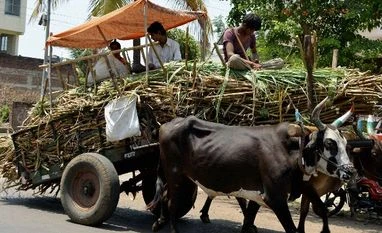 "A fourth of sugar mills to remain un-operational next season")


