The Bengaluru airport, the third-busiest in the country, now has a new board following Fairfax's acquisition of a 38 per cent stake in the airport.
The Economic Times on Friday reported that Fairfax Chairperson Prem Watsa, two other group executives Chandran Ratnaswami and Harsha Raghavan, and HDFC chairperson Deepak Parekh have been inducted in the Bengaluru airport board as additional directors.
Last week, Fairfax completed its acquisition of 38 per cent stake in the Bengaluru International Airport Limited (BIAL), which includes 33 per cent stake of GVK Group and five per cent shares held by Zurich Airport. The deal value was around Rs 2,200 crore.
GVK Group was not a part of the original consortium which commissioned the greenfield airport in 2008 and it took over the management after acquiring stakes from Larsen & Toubro and Zurich Airport in late 2009-early 2010.
GVK Group Chairperson GVK Reddy will continue as co-chaiperson of BIAL and his son, G V Sanjay Reddy, will continue as it's managing director and oversee operations and expansion of the airport, a company spokesperson said.
Expansion work includes the construction of the second runway and a new terminal building (T2) to handle 45 million additional passengers by 2027-28.
Expansion has been necessitated due to the rapid growth in air traffic, which has put a strain on airport infrastructure. Bengaluru's airport traffic has grown over seven times to 22 million passengers in the past fifteen years.
Traffic growth is faster than estimates and the airport has crossed 22 million passengers in FY17, one year ahead of estimate. Earlier, it was expected that the airport would cross the 22 million mark in FY18.
Plans for the new terminal too are being tweaked as a result. Now, the second terminal will be built to handle 25 million additional passengers in the first phase by 2021. The earlier plan was to build the terminal for 20 million passengers in the first phase. Terminal construction is expected to start next year.
Slot constraints in Chennai and Mumbai mean airlines have been unable to add flights from these two cities and that has worked in favour of Bengaluru. AirAsia India made it it's first base when it launched operations. Vistara also selected Bengaluru as it's second base while Jet Airways is developing the Karnataka capital as it's third base for international flights after Mumbai and Delhi. Jet has started flights from Bengaluru to Colombo and Singapore and has plans to connect the city to Bangkok and Amsterdam.

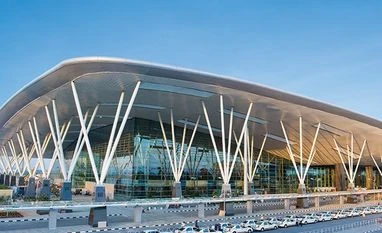 "Bengaluru airport gets new board; new terminal to cater to traffic growth")











