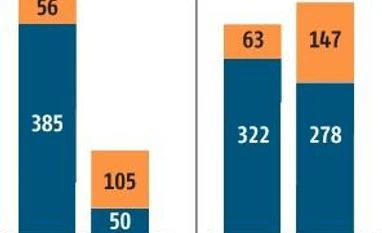
This is because returns in the insulin business have come under pressure globally.
Around 75 per cent of the company’s overall $600 million investments in biosimilars made so far is in insulins and the remaining in non-insulins (oncology and other drugs). Analysts feel that Biocon’s investments towards non-insulins is set to rise and the share of insulin business in overall investments would taper down to 47 per cent between FY19 and FY22.
As such, Biocon intends to invest an additional $810 million over the next four years to generate a $500 million revenue by FY23.
Deepak Malik, analyst at Edelweiss, is of the opinion that insulins, unlike monoclonal antibodies (MAbs), have a high entry barrier and the global market is dominated by Sanofi, Eli Lilly and Novo Nordisk, which have 88 per cent share. He feels insulins thus have a low asset run, as well as unattractive profitability and return on capital employed (RoCE).
The company did not respond to queries sent citing silent period before quarterly results.
Malik highlighted that other biologics players like Sandoz, Pfizer, Samsung and Celltrion do not have much presence in the insulin business. In contrast, Biocon has bulk of its investments in the insulin space.
The global insulin market has been pegged at $43 billion and is expected to expand at a compound annual growth rate or CAGR of 8.8 per cent over the next five years.
Malik felt that market share gain for Biocon is likely to be challenging as precedents show that the third player often settles for a single digit market share. There are around 40 players in the global insulin market, but it is dominated by three players.
Biocon is now planning to focus on other molecules and has tied up with Sandoz for the development of second generation biosimilar products. While Sandoz would be responsible for commercialisation in the US and EU, Biocon would lead the commercialisation in the remaining markets of the world.
“Most key biosimilar projects tied up with Mylan have concluded and Biocon’s R&D costs related to the Mylan partnership have started decreasing. However, we expect R&D costs associated with the Sandoz agreement to begin in 2019, as some products will move into the preclinical and clinical phase,” India Infoline analysts noted.
The new biosimilars launched have already started contributing to the revenues — in fact, company biologics segment’s revenue increased over 40 per cent sequentially in Q2FY19, driven by the launch of Pegfilgrastim (chemotherapy drug) in the US as well improved sales of other biosimilars in the emerging markets. The profit share from Pegfilgrastim’s US launch led to the biologics business’s Ebitda margins improving quarter on quarter from 11 per cent in Q1FY19 to 25 per cent in Q2FY19.
One subscription. Two world-class reads.
Already subscribed? Log in
Subscribe to read the full story →
Smart Quarterly
₹900
3 Months
₹300/Month
Smart Essential
₹2,700
1 Year
₹225/Month
Super Saver
₹3,900
2 Years
₹162/Month
Renews automatically, cancel anytime
Here’s what’s included in our digital subscription plans
Exclusive premium stories online
Over 30 premium stories daily, handpicked by our editors


Complimentary Access to The New York Times
News, Games, Cooking, Audio, Wirecutter & The Athletic
Business Standard Epaper
Digital replica of our daily newspaper — with options to read, save, and share


Curated Newsletters
Insights on markets, finance, politics, tech, and more delivered to your inbox
Market Analysis & Investment Insights
In-depth market analysis & insights with access to The Smart Investor


Archives
Repository of articles and publications dating back to 1997
Ad-free Reading
Uninterrupted reading experience with no advertisements


Seamless Access Across All Devices
Access Business Standard across devices — mobile, tablet, or PC, via web or app
)