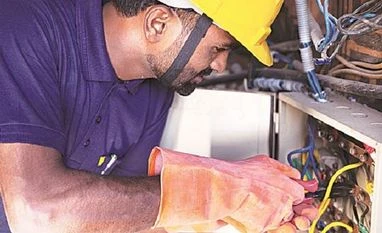
The two listed entities of automotive (auto) parts maker Motherson Sumi (Motherson) after restructuring earlier this year have exhibited contrasting returns since getting listed. While Samvardhana Motherson International (SAMIL) - formerly Motherson Sumi Systems - with global operations under its fold has slid 25 per cent over the past six months, Motherson Sumi Wiring India (MSWIL), predominantly earning revenue from the domestic market, has outperformed significantly, with gains of 29 per cent during this period.
While MSWIL is a wiring harness solution provider catering to domestic automakers, SAMIL has multiple product lines, including vision systems (mirrors), plastic body parts, and wiring harness it supplies to global auto majors.
In a recent report, research analysts Shashank Kanodia and Raghvendra Goyal of ICICIdirect advised investors to switch their holdings from SAMIL to MSWIL. While SAMIL is facing macro uncertainty in the global markets, the reason for the switch is the more stable demand environment in the domestic market.
SAMIL’s stock price has been under pressure in the past amid concern over demand-and-supply disruptions in its overseas markets, they add.
These concerns - both on demand and supply fronts - are also being reflected in the July-September quarter (second quarter, or Q2) result expectations of global suppliers of auto parts.
Say analysts, led by Joseph George, of IIFL Securities, “In recent quarters, Motherson has been impacted by lower car production globally, as well as lack of pass-through due to rise in costs. Q2 would have seen further increase in energy costs.”
The brokerage is expecting slight sequential improvement in margins, banking on successful price negotiations with original equipment manufacturer customers. Full margin normalisation, which it has factored into 2023-24 (FY24)/2024-25 estimates, may take a few more quarters, it observes.
With a ‘buy’ rating on the company, IIFL Research had downgraded its earnings estimates after the first quarter results of SAMIL by 30 per cent for 2022-23 (FY23) and 13 per cent for FY24 to factor in delay in pass-through.
Although there is caution on the near-term outlook for SAMIL, the company continues to make small-ticket acquisitions. Recently, it took control of Ichikoh Industries, a Japanese maker of auto mirrors, for an enterprise value of Rs 300 crore. While the deal at 4x its enterprise value-to-operating profit and 0.3x sales is attractive (Ichikoh generates Rs 900 crore in sales and Rs 75 crore of operating profit), it won’t move the needle as far as impact on sales (1-2 per cent of consolidated revenue) or net profit is concerned.
However, Axis Securities believes the deal is positive as it enhances SAMIL’s presence in Japan which accounts for 30 per cent of global car production, diversifies its client base, gives access to manufacturing, and research and development base.
A key positive for SAMIL, notwithstanding near-term worries, is its product profile (mirrors, plastic body parts, and wiring harness) which is immune to the electric vehicle (EV) transition.
Key metrics the Street will focus on are rising utilisation levels at its greenfield plants globally and operating leverage as demand levels start to improve.
For MSWIL, the prospects - both on demand and outlook fronts - remain resilient. With passenger vehicle and two-wheeler production (wholesale volumes) up 12-14 per cent on a sequential basis in Q2, the company is expected to see a sequential jump in sales.
While SAMIL is expected to report flat sequential sales, MSWIL could see 9 per cent growth. Improvement in cost pass-through and operating leverage are margin tailwinds, says IIFL Research.
MSWIL’s operating profit margins are about twice SAMIL’s.
MSWIL has outperformed the domestic auto market, with revenue growth of 15 per cent between 2009-10 and 2021-22 (auto industry delivered a revenue growth of 9 per cent in that period) due to rising premiumisation, strict safety norms, move towards lower emissions, and electrification, leading to significant rise in the wiring harness content per vehicle.
Analysts Ronak Sarda and Poorvi Banka of Systematix Research expect this trend to sustain. In addition to continued premiumisation, emerging trends in the auto industry, such as electrification, connected mobility, and autonomous or self-driving vehicles, are expected to enhance opportunities in the wiring harness industry.
EVs require high-voltage wiring harnesses, further driving a 20-30 per cent rise in wiring harness content per vehicle in contrast with their internal combustion engine counterparts, they add.
Brokerages also expect the company to sustain its return on invested capital (higher return ratios are a key investment argument) at 50 per cent over FY23-24.
Given the near-term prospects, investors can consider the domestic play (MSWIL) on dips.