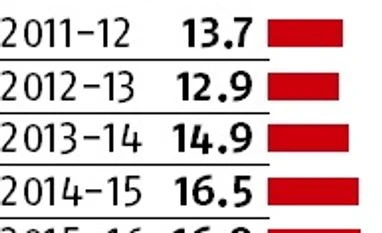
Growth in apparel exports may stay muted for a consecutive year in FY17, as demand from key importing countries remained subdued. On the back of the global apparel trade contracting by one per cent to $432 billion (Rs 28 lakh crore) in 2016, apparel exports, according to the Apparel Export Promotion Council’s (AEPC’s) estimates, were likely to close 2016-17 at $17.3 billion (Rs 1.12 lakh crore), up by roughly two per cent from $16.9 billion (Rs 1.10 lakh crore) in the previous financial year.
Credit rating agency Icra also expects India to report tepid growth of one per cent in dollar terms.
This is also evident from the fact the industry clocked exports of $15.5 billion (Rs 1 lakh crore) during April 2016-February 2017, a growth rate of just 0.6 per cent over the last year, according to AEPC sources.
While sluggish demand from importing countries has been the primary reason for the muted guidance, what also works against India is its heavy reliance on cotton amid an increasing share of lower-priced man-made fibre-based apparels by other competing markets such as Vietnam and Bangladesh.
“The other competing nations import almost all the raw materials and hence have a better economies of scale than India, which is dependent heavily on the domestic industry, predominantly driven by cotton,” said an AEPC official, on condition of anonymity.
“The exports in value terms have declined, following an increase in the share of man-made fibre-based apparels, which are lower in value vis-à-vis cotton-based apparels. This in turn has been caused by the improved competitiveness of polyester vis-à-vis cotton during the past few years,” Icra said in its March update.
Apparel exports to the US are estimated to have grown by two per cent in 2016. “While this growth is modest compared to the healthy growth clocked in prior years, the growth quantum looks satisfactory in the backdrop of a one per cent decline in import quantity of the US. Similarly, apparel export quantity to the European Union (EU) is estimated to have grown six per cent in 2016, compared to a five per cent in total apparel import quantity of the EU,” Icra said.
On the other hand, exports to the UK have fallen to $1.2 billion (Rs 7,800 crore) from $1.6 billion (Rs 10,400 crore) due to sluggish demand, according to AEPC sources.
The previous three quarters have seen fluctuating growth for the Indian apparel industry. Top garment manufacturers such as Gokaldas Exports Limited and Mafatlal Industries, among others, have posted net loss in the third quarter of the current financial year, against a profit in the corresponding period in FY16. Gokaldas Exports posted a net loss of Rs 21.84 crore for the quarter ended December 31, 2016, against a net profit of Rs 25.92 crore for the corresponding period in FY16. It also posted quarterly revenue from operations of Rs 198 crore, down by 19 per cent as compared to Q3 of FY16.
"The decline in revenue in Q3 FY17 was due to continued impact of loss of business from a key export customer and delay in onboarding and stabilising operations of a new customer. The company has been able to stabilise operations of the new customer towards latter part of the quarter and commence deliveries, complete servicing of the same is expected in the fourth quarter," the company had said.
Similarly, Mafatlal Industries registered a net loss of Rs 12.5 crore in Q3 of FY17 against a net profit of Rs 1.74 crore in the Q3 of FY16. On the other hand, Arvind Limited posted net profit after taxes, minority interest and share of profit/(loss) of associates of Rs 75.62 crore for the quarter ended December, compared with Rs 90.46 crore for the year-ago period.
Going forward, Icra anticipates domestic focused apparel manufacturers to do better than exporters.
"Given the weak trend in global apparel trade, the domestic market-focused apparel manufacturers are expected to perform relatively better than exporters for second consecutive year in FY17. However, given the temporary pressures observed in domestic consumption owing to demonetisation, the gap between the growth rates is likely to narrow significantly. Thus, compared to an estimated revenue growth of 10 per cent for domestic market-focused players, the revenues of exporters are expected to grow by nine per cent in FY17 for the entities in Icra's sample set," it said, while adding the operating profit margins of the domestic market-focused apparel manufacturers remain higher than the apparel exporters.
In FY16, too, the domestic players had reported a much higher growth rate of 14 per cent vis-à-vis six per cent growth rate achieved by exporters. "Overall, FY16 and FY17 have been years of weak growth for apparel manufacturers compared to the recent past, wherein the revenues of both apparel exporters and domestic players grew at a CAGR of 13-14 per cent during 2011-2015," Icra further stated.