The country’s top car-maker, Maruti Suzuki India Ltd (MSIL), has never had a better ride. It sold a record number of cars in the first nine months of 2016-17, clocking its best revenue and profits. The company has not only grown its share in the domestic market, but has also improved its product portfolio by launching new and premium models, including sports utility vehicles (SUVs). This helped in a higher realisation per vehicle. In spite of rising competition from rivals, the car-maker now has 47.3 per cent share of the passenger car market, slightly higher than the 46.8 per cent share it had in 2015-16.
In spite of a series of challenges in 2016-17, ranging from disruption in supply of a key component to demonetisation, the company’s domestic sales volume grew more than nine per cent during April-December 2016 to 1.06 million vehicles, and it exported 90,600 cars. The nine-month revenue grew 18 per cent to Rs 48,904 crore, while net profit soared 45 per cent to Rs 5,628 crore. The stock market has rewarded this outstanding growth and MSIL’s share price hit a new high of Rs 6,230 on February 8, days after the December 2016 quarter results were announced.
“The company could once again outperform the industry. Immediately after demonetisation there was some impact and bookings dropped initially. However, gradually the trend reversed by the end of the quarter. We increased our engagement in listening to customers to know their issues and reoriented our sales strategy,” said Ajay Seth, chief financial officer.
MSIL, the Indian arm of Japanese auto major Suzuki, has also become a bigger entity than its Japanese parent in revenue terms for the April-December 2016 period. The change comes on the back of double-digit growth in Indian operations, while sales in Japan are declining. The India operations brought revenue of 708 billion yen for the parent Suzuki Motor Corporation (SMC), while Japanese sales stood at 699 billion yen.
MSIL already sells more vehicles than SMC does in Japan, and enjoys a greater market capitalisation than its parent. SMC is faced with a declining market in Japan, whereas its Indian subsidiary is seeing a capacity constraint, leading to a waiting period of several months for some of its best-selling models. For instance, SMC’s sales in Japan declined more than three per cent to 0.49 million vehicles during April-December 2016, while Maruti’s domestic volumes grew more than nine per cent to 1.06 million vehicles.
MSIL’s effort to establish itself in the premium vehicle category also got a leg-up through Nexa, a separate sales network that was started in mid-2015. Started as a single-product (S-Cross) store, Nexa today brings one-tenth of the company’s domestic sales.
MSIL now enjoys a waiting period of several months on models such as the Baleno, Brezza and Ignis. The waiting period is expected to ease to some extent, as SMC’s new manufacturing facility in Gujarat has been made operational recently. The new plant, in which the entire investment is being done by SMC, will sell vehicles to MSIL at cost price. The incremental volumes from the new plant will add to the company’s sales and increase market share further. This, the company reckons, will also be reflected in revenue and profitability from 2017-18 onwards and help it reach its 2020 target of selling two million vehicles.

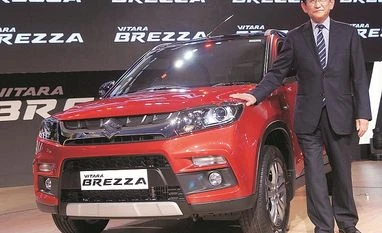 "Maruti Suzuki's breezy FY17 ride makes it BS Star MNC of the Year 2016")











